Pressuring the victim: Trump, Musk and Ukraine’s vulnerability
Analysis: Trump’s pressure on Kyiv and restrictions on Starlink expose Ukraine’s military dependence. What has been established and what remains unclear.
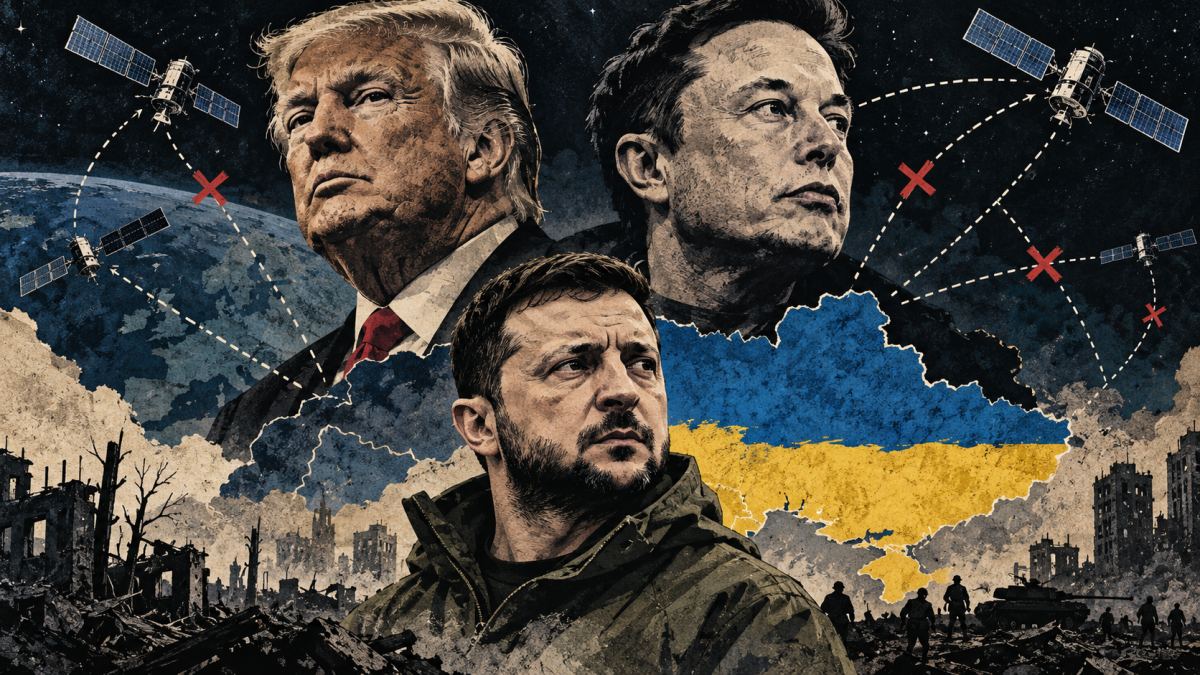
Ukraine’s ability to defend itself also depends on decisions made thousands of miles from the front: a suspended arms shipment, intelligence that stops arriving or a satellite connection with reduced capabilities. Since Donald Trump returned to the U.S. presidency in January 2025, that dependence has repeatedly become a means of pressuring Kyiv. The problem is both political and military: weakening an invaded country to force it to negotiate strengthens the invader’s position.
The latest episode concerns SpaceX services used by Ukrainian forces. On October 14, Ukrainian officials reported sudden restrictions that disrupted military missions. Presidential adviser Serhii Beskrestnov explained that the limitations affected terminals operating on the move under the Starshield military service and included a threshold of roughly 160 kilometers per hour. According to The Kyiv Independent, the Defense Ministry and units in the field also reported connection problems.
What happened needs to be described precisely. Available reporting does not describe a complete shutdown of all satellite services for the entire Ukrainian military. It describes restrictions that hampered attack drones, interceptors and other operations. The speed in question refers to the movement of the terminals, not internet download speeds. In a system on which aircraft depend in combat, such a restriction can disable capabilities even while other users remain connected.
Moreover, on October 15, a Defense Ministry source told The Kyiv Independent that service on the move had been restored. The same report left important questions open: it did not establish whether all restrictions had been lifted and included accounts of uneven performance. It would be inaccurate to portray the episode as a total blackout continuing indefinitely. The disruption and its impact, however, are documented.
Zelensky publicly called for service to be restored during an interview with Piers Morgan. According to Deutsche Welle, he said he hoped it was a mistake or a major technical problem. Musk responded by attributing decisions on speed and usage limits for military systems to the U.S. armed forces and, ultimately, the president. His statement matters, but it is not independent evidence of who ordered this particular restriction.
The distinction matters: there is evidence of operational harm and there are allegations of political motives; the precise chain of decision-making has yet to be publicly established.
Pressure that began much earlier
The reversal of responsibility emerged early in Trump’s second term. In February 2025, the U.S. president falsely blamed Ukraine for starting the war. As Associated Press noted in its fact-check of his remarks, Vladimir Putin ordered the full-scale invasion on February 24, 2022, following Russia’s annexation of Crimea and aggression in the Donbas dating back to 2014. Shifting responsibility to Kyiv changes the starting point for any negotiation.
Trump also portrayed Zelensky as a leader without democratic legitimacy. Deutsche Welle’s fact-check debunked his claims that Zelensky supposedly had minimal public support and noted that Ukrainian law prohibits elections under martial law. Nor can the difficulties of organizing a free vote with occupied territories, millions of displaced people and soldiers deployed in the field be reduced to a personal decision by the president.
The shift extended to diplomacy. On February 24, 2025, the United States joined Russia in voting against a United Nations General Assembly resolution condemning Russian aggression and calling for the withdrawal of its troops. Washington thereby broke with its European allies on a fundamental issue: identifying who was responsible for the invasion, as Associated Press documented.
Concrete decisions followed. After the February 28 confrontation in the Oval Office, Washington suspended military aid and intelligence sharing. German public broadcaster ARD documented both the interruption and the resumption on March 11, after Ukraine accepted a U.S. ceasefire proposal. The suspension was temporary; it also demonstrated that tools essential to Ukraine’s defense could be used to extract political concessions from Kyiv.
Russian oil and restrictions on Ukraine
The October 2026 crisis follows the same logic in the energy sector. Reuters reported that Trump had lifted sanctions on Russian diesel while demanding that Ukraine stop attacks on Russian refineries and advocating Zelensky’s replacement. The communications restrictions came as relations deteriorated.
The imbalance is clear: easing Russia’s export difficulties helps its revenues; limiting Ukraine’s military options reduces pressure on Moscow. Associated Press described the diesel agreement and the political attacks on Zelensky as victories for the Kremlin at a critical point in the war.
That supports a forceful critique of the effects of Trump’s policies without attributing an unproven secret intention to him. A decision can objectively benefit Putin even if its public justification is to lower fuel prices or accelerate negotiations.
It also demands care in handling allegations about intelligence. Recent failures to provide warnings of Russian missile attacks raised suspicions of another U.S. suspension. However, Ukrainian and U.S. sources consulted by The Kyiv Independent said no such decision had been made. The absence of a particular warning does not, by itself, establish a deliberate, across-the-board cutoff.
Musk and the power of private infrastructure
Musk’s role brings together two forms of power: he controls a company indispensable to certain Ukrainian operations and actively participates in the political dispute over the war. As Euronews reported, in October he publicly backed the verbal attacks on Zelensky, saying he had gone too far, following a video of Trump criticizing Ukrainian attacks on Russian oil facilities.
That political alignment does not prove that Musk personally carried out an order to punish Ukraine. It does make dependence on infrastructure whose owner is involved in the conflicting interests surrounding its use particularly troubling.
Poland has been raising this issue for some time. In March 2025, Foreign Minister Radosław Sikorski pointed out that his country was funding Starlink services for Ukraine at a cost of about $50 million a year. After Musk emphasized that Ukraine’s front line could collapse without his system, Sikorski suggested seeking alternatives if SpaceX ceased to be a reliable supplier. Musk’s response included a personal insult, as the Polish news agency PAP documented.
The episode reveals the problem that warrants speaking of oligarchic power: a concentration of wealth, strategic infrastructure and political influence capable of shaping the decisions of sovereign states. Starlink’s vital contribution to Ukraine’s resistance does not remove that vulnerability; it helps explain its scale.
A critique that needs no exaggeration
Trump’s policies have not followed a consistent course either. In July 2025, he announced new weapons for Ukraine and threatened sanctions against buyers of Russian exports, in a shift Reuters linked to his frustration with Putin. That episode belongs in any honest assessment.
Precisely for that reason, the strongest charge concerns a pattern of pressure and unpredictability: undermining Zelensky’s legitimacy, turning assistance into negotiating leverage and taking measures that, at critical moments, strengthen Russia’s position.
Describing this as “sabotage” is a political interpretation that must rest on those facts, without presenting clandestine coordination between Trump, Musk and Moscow as proven. Available sources document harm, threats and publicly aligned positions; they still leave unanswered questions about the specific restrictions imposed in October.
For Ukraine, the consequence is immediate: defending itself requires tools whose operation can be exposed to sudden decisions made by others. For Europe, the warning is strategic. Funding equipment is not enough when effective access depends on a private company and an administration willing to use that dependence as a source of pressure. Sovereignty also rests on who can restrict a connection when a country needs to defend itself.