Apple and the Five Trillion Dollar Value of Keeping Customers
Fifty years after its founding, Apple still depends on desirable devices. Its accounts reveal how the iPhone and services reinforce each other, and what its valuation demands.
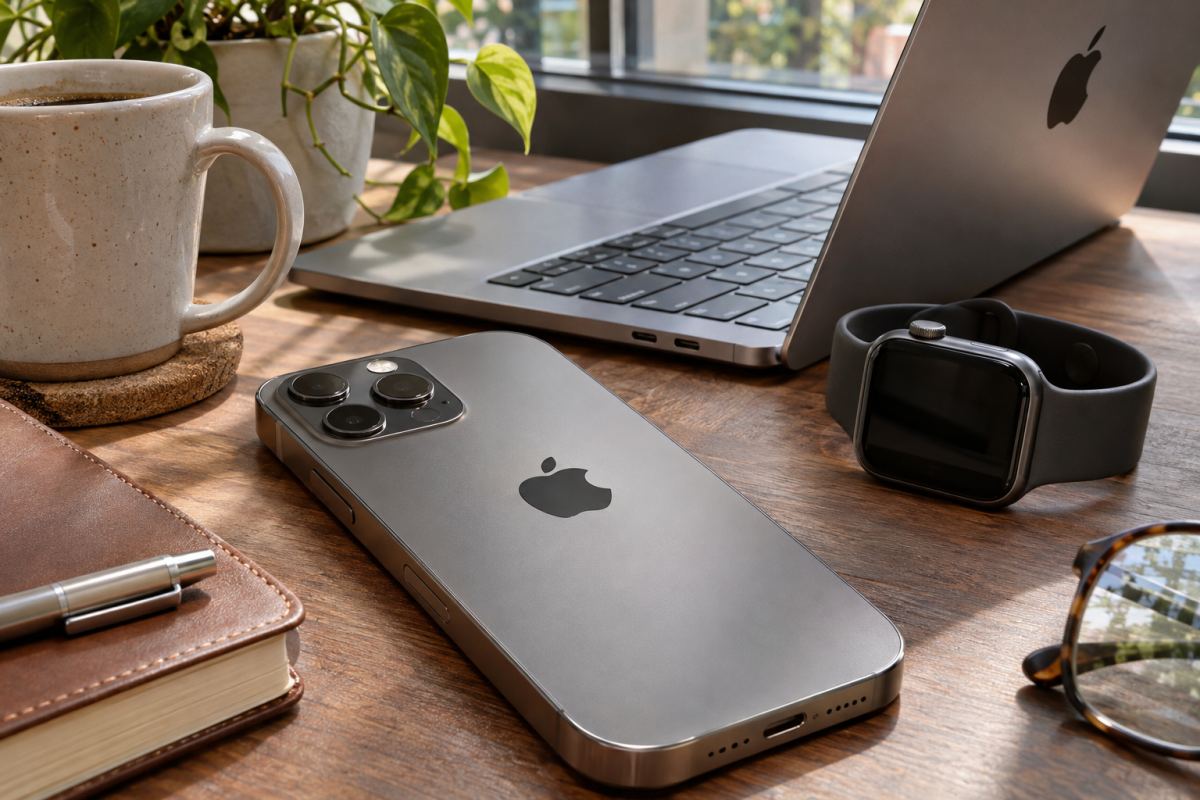
Apple has spent fifty years persuading people that a computer can be personal. Its financial achievement has been to make that relationship last beyond the purchase. A customer buys an iPhone, stores photographs in iCloud, pays for applications, perhaps adds a watch, and eventually replaces the phone. Each decision can make the next Apple purchase more convenient.
The scale is extraordinary. In the year ended September 26, 2026, Apple generated $478.834 billion in revenue and $132.175 billion in net income. On the November 5 reference snapshot, its shares traded around $344.17 and its stock market value approached $5 trillion. Those figures describe different things: annual sales, annual profit and the price investors collectively place on the company's shares. Understanding their connection explains both Apple's strength and the expectations it must keep meeting.
A company built around the complete product
Apple began in 1976 with Steve Jobs and Steve Wozniak and the ambition to bring computing to individuals. Its fiftieth anniversary account traces a path through the Macintosh, iPod, iPhone and newer devices. The important continuity is control over the experience: hardware, software and the way people use them.
That approach has commercial consequences. A manufacturer selling interchangeable hardware competes heavily on specifications and price. Apple can compete on the combined experience of the device, its operating system, applications, support and accessories. Integration requires expensive development and demanding coordination, but it also gives the company more ways to distinguish a product than a faster component alone.
The iPhone's introduction in January 2007 crystallized the strategy. Apple presented a phone, music player and internet communications device together. The proposition was not simply that three products could fit into a pocket. A common interface could make their functions easier to reach, turning the phone into a platform for activities that had belonged to separate businesses.
Successive products widened that relationship. The Mac and iPad serve different computing needs; the Watch and AirPods extend the phone into other parts of daily life. Their usefulness can reinforce one another. This does not mean every customer buys the whole range. It means Apple can sell additional products to an audience already familiar with its software and stores.
John Ternus now leads the company as chief executive. His background is in hardware engineering: he joined Apple in 2001, became a vice president in 2013 and entered the executive team in 2021. For a business increasingly valued for recurring services, choosing a leader with that history underlines how much still depends on devices people want to own.
The iPhone still pays the bills
Apple's fiscal 2026 figures resist a tempting description of the company as primarily a subscription business. The iPhone produced $254.098 billion in revenue, approximately 53% of the total. Services contributed $123.301 billion, about 26%. The remaining sales came from the Mac, iPad and the wearables, home and accessories category.
Services matter because a device sale can create years of subsequent spending. Storage, digital content, payments and distribution through Apple's platforms produce different kinds of revenue, however. They should not all be treated as identical monthly subscriptions. Some depend on transactions, commercial agreements or activity within the ecosystem.
The two engines also depend on each other. A growing services business benefits from a large population of active devices and customers willing to spend through them. The phone remains central to attracting and retaining those customers. Services can soften the effect of uneven replacement cycles, but they cannot make the underlying hardware relationship irrelevant.
Annual revenue increased about 15% from $416.161 billion in fiscal 2025. The composition was significant: iPhone sales rose from $209.586 billion, while services advanced from $109.158 billion. Growth therefore came from both the original hardware engine and the business built around its installed customer base.
The September quarter delivered $114.477 billion in revenue, up 12% from a year earlier. It closed Apple's fiscal year; it was not the holiday quarter. That distinction matters when comparing the result with companies reporting on a calendar year, or when interpreting how much of a new product cycle those accounts capture.
Why the balance sheet understates the business people recognize
At fiscal year end, Apple reported $404.548 billion in total assets, $292.455 billion in liabilities and $112.093 billion in shareholders' equity. The accounting identity is straightforward: assets less liabilities equal equity. None of those figures is supposed to equal the company's stock market capitalization.
The difference is especially revealing at Apple. A balance sheet records assets under accounting rules; it does not assign a market price to the full value of the brand, the customer relationship or the ability to develop the next successful device. Investors also price anticipated earnings. A market value far above book equity expresses expectations about those future earnings, rather than the resale value of the assets already recorded.
Cash generation supplies a more immediate measure of financial power. Operating cash flow reached $145.097 billion in fiscal 2026. This is money generated through operations before investment and financing flows, not an additional profit figure to add to net income. It helps finance research, equipment, supplier commitments and returns to shareholders.
Research and development spending rose to $45.765 billion from $34.550 billion. That is a substantial commitment even for Apple. Maintaining an integrated product range requires work on chips, operating systems, applications and physical design at the same time. Spending supports that effort, although an expense total cannot tell investors which projects will ultimately become successful products.
Apple also returns cash through repurchases and dividends. On November 2, it declared a quarterly dividend of $0.27 per share. Repurchases can increase each remaining share's claim on earnings by reducing the share count, but the price paid matters. Buying shares at an expensive valuation creates a different economic result from buying the same earnings stream cheaply.
Control brings customers and regulators
The features that strengthen the ecosystem also create its sharpest conflicts. Developers want access to Apple's customers, while Apple sets conditions for distribution and payment. Consumers may value convenience and security, yet rivals argue that restrictions can make switching platforms or reaching customers unnecessarily difficult.
In March 2024, the US Justice Department sued Apple over alleged monopolization of smartphone markets. Those were government allegations, not a finding of liability. In April 2025, the European Commission fined Apple €500 million for breaching the Digital Markets Act's anti-steering obligation, concerning developers' ability to direct users toward alternative offers. The two actions have different legal bases and should not be merged into one case.
For the business model, the issue extends beyond any individual fine. Changes to distribution rules or payment arrangements can affect how much value Apple captures from activity on its devices. A company can keep selling attractive hardware while facing pressure on the commercial terms of its platform.
Manufacturing creates another exposure. Apple depends on a global network of suppliers and assembly partners, while selling into markets with different trade rules and political priorities. Diversifying production is a complex operational undertaking: the availability of skilled workers, components, logistics and reliable scale matters alongside the location of a factory.
At its November 2 earnings presentation, Apple warned that rising memory-chip costs would pressure gross margin in the quarter ending in December. Reuters reported that the company projected a margin of 45% to 46%, compared with 47.9% in the September quarter; that is a forecast, not a completed result.
On November 10, Apple announced that American and British Sign Language interpretation would become available on selected Apple TV titles beginning November 13. The feature expands access to part of its services catalog; the company has not provided a revenue estimate attributable to it.
The price of remaining indispensable
At roughly $5 trillion, Apple is valued for much more than one successful financial year. Using the reference market value and fiscal 2026 net income gives a simple trailing earnings multiple of about 38. That calculation is an approximate comparison of a dated market value with historical profit, not a forecast or a judgment that the shares are cheap or expensive.
The practical question is what sustains the earnings behind that price. Watch whether the iPhone continues attracting spending, whether services growth strengthens the customer relationship, and whether new technology improves products enough to encourage upgrades. Rising research spending deserves attention alongside the results it eventually produces.
Apple's history shows the value of making technology understandable and desirable. Its next chapter must preserve that skill at a scale its founders could scarcely have imagined. The company does not need every device to change the world. It does need enough customers to believe that their next important device should still come from Apple.