Nvidia Built the Machines Behind AI and Now Faces Its Biggest Test
A graphics specialist became a supplier of entire AI computing systems. Its history, exceptional profits and powerful customers explain the opportunity and the risks.
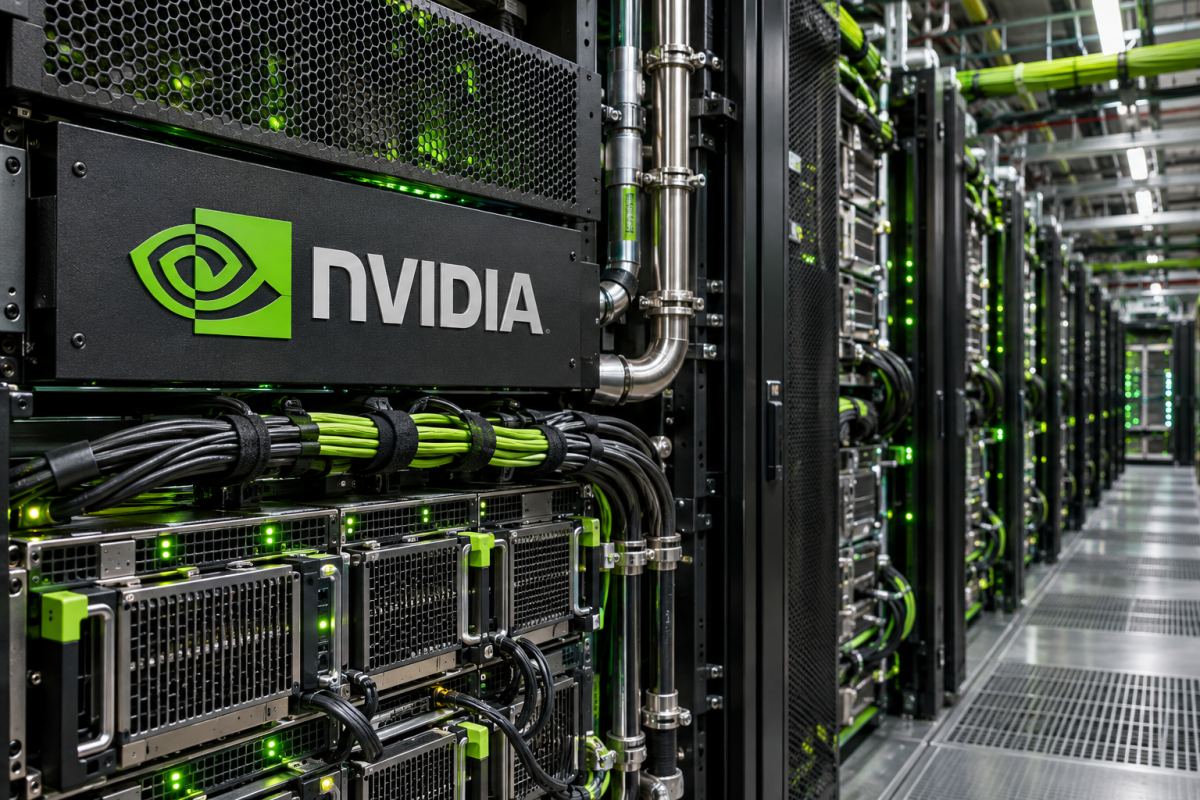
NVIDIA's most important product is increasingly something few consumers will ever see. Behind an artificial intelligence service sits a collection of processors, memory, networking and software, often assembled into racks that function as one computing system. NVIDIA supplies much of the technology that makes those systems work together.
That position has transformed its finances. Revenue reached $215.938 billion in fiscal 2026, the year ended January 25, 2026, up 65%. By the November 5 market snapshot, the shares traded around $181.60 and the company was worth approximately $4.385 trillion. The business that helped make video games look more convincing now carries enormous expectations about how companies will build and pay for artificial intelligence.
The long route from graphics to AI
Jensen Huang, Chris Malachowsky and Curtis Priem founded NVIDIA in 1993. Its original opportunity was computer graphics, a field in which many calculations must happen simultaneously to create an image. The company's timeline identifies the 1999 introduction of the GPU, or graphics processing unit, as a defining step.
The deeper opportunity emerged when that parallel processing could be used for work beyond graphics. A conventional central processor is designed to handle a broad range of tasks. A GPU can divide suitable workloads across many computing elements. The distinction is useful for scientific calculations and, crucially, the mathematical operations involved in training and running neural networks.
Hardware alone would not have made the transition easy. NVIDIA unveiled CUDA in 2006, giving developers a programming platform for using its GPUs for general computation. Software tools, libraries and accumulated developer experience made the chips usable across more disciplines. A capable processor becomes much more valuable when a research team can actually build and maintain its work on it.
The company points to the 2012 AlexNet breakthrough in computer vision as another milestone. Deep learning's progress helped reveal the commercial potential of GPU computing. NVIDIA had spent years developing technology and tools before the current spending surge made artificial intelligence infrastructure a central concern of corporate budgets.
That history explains why describing NVIDIA solely as a designer of fast chips misses an important part of its position. Customers also buy access to a mature software environment and a coordinated system. A competing component must fit into real workflows, with developers, support and reliable performance across a complete installation.
A system business with exceptional margins
NVIDIA designs processors and computing platforms while relying on manufacturing and supply partners to produce the physical components. Its growing data center offering includes networking and systems technology alongside GPUs. Buyers evaluating a large deployment care about how efficiently all those pieces communicate, draw power and run useful workloads.
The economics were striking in fiscal 2026. NVIDIA reported $120.067 billion in GAAP net income and $130.387 billion in operating income on its $215.938 billion of revenue. Its GAAP gross margin was 71.1%. Gross margin measures revenue left after the direct cost of goods sold; it still has to cover research, selling costs and other expenses before becoming profit.
Net income represented about 56% of annual revenue. That ratio reflects this particular period and the accounting items included in it. It should not be treated as a permanent rule for the semiconductor industry, where product transitions, competition, supply conditions and changes in demand can reshape profitability.
Operating cash flow was $102.718 billion for the year. The difference from net income is a reminder that an income statement and a cash flow statement answer different questions. Working capital, payment timing and noncash items affect how accounting earnings turn into cash available to fund the business.
The latest reported quarter at the November 5 cutoff was even larger. For the second quarter of fiscal 2027, ended July 26, revenue reached $96.221 billion, up 106% from a year earlier. Data center revenue was $89 billion. That concentration shows how thoroughly demand for AI infrastructure has reshaped a company still familiar to many people through gaming cards.
Quarterly GAAP net income was $59.688 billion and gross margin reached 75%. NVIDIA's next-quarter revenue outlook was $108 billion, plus or minus 2%. That was a management forecast announced with the results, not a completed quarter. The company explicitly assumed no data center compute revenue from China in that outlook.
The assets behind a company worth trillions
NVIDIA reported $206.803 billion in total assets at its January fiscal year end. By July 26, the balance had risen to $320.272 billion. Comparing those dates is more informative than placing an undated asset figure beside a current share price: a rapidly growing company can change substantially within six months.
At the July date, cash and cash equivalents were $22.443 billion, and marketable debt securities added $34.143 billion. Together they provided roughly $56.6 billion in those two categories. Marketable equity investments are a separate category and carry different risks; they should not casually be added to cash when describing liquidity.
Total liabilities were $91.288 billion. The balance sheet also included short- and long-term debt, but liabilities encompass more than borrowing. Supplier obligations, accrued expenses and other commitments help explain why the headline asset total is not a pot of money freely available to shareholders.
For investors, the shares trade on Nasdaq under NVDA. The reference capitalization of $4.385 trillion divided by fiscal 2026 net income gives an approximate trailing earnings multiple of 36.5. Because the business has expanded sharply since that fiscal year ended, the calculation is a backward-looking yardstick. It does not capture the earnings of an unreported future year.
NVIDIA also pays dividends and repurchases shares. In the July quarter, it returned $26 billion to shareholders through those channels. Such distributions demonstrate financial capacity, but the company's longer-term value depends on profitable demand for its systems rather than the size of a repurchase authorization alone.
Its customers are also potential competitors
The central commercial risk is unusually intimate: some of the largest buyers have the resources to design more of their own computing technology. A cloud provider can remain an important NVIDIA customer while developing specialized chips for selected workloads. Those decisions depend on performance, software compatibility, availability and the total cost of operating a system.
NVIDIA's integrated platform makes displacement difficult, but it does not make competition disappear. Customers may seek a second supplier, redesign a workload or choose a different balance between general flexibility and specialized hardware. The more they spend on computing, the greater their incentive to examine those choices carefully.
Supply introduces another set of dependencies. Advanced fabrication, packaging and high-bandwidth memory must arrive in the right quantities at the right time. A design can be excellent and still encounter constraints elsewhere in the production chain. New generations also require buyers to coordinate facilities, cooling, power and installation schedules.
Export restrictions add political uncertainty. The China assumption in NVIDIA's quarterly outlook illustrates how government rules can change the addressable market independently of technical demand. A forecast that excludes sales in a region does not prove that all regulatory risk has been removed from the business.
The final question concerns the customers' returns. Infrastructure spending can rise quickly while the eventual economics of the services built on it remain unsettled. NVIDIA earns revenue when it sells its technology; its customers must then turn that investment into useful, commercially sustainable activity. The two businesses are connected, but their profits do not arrive automatically together.
An investigation and a stock-market slide
On November 8, Nvidia’s board announced an independent investigation after reports that chief executive Jensen Huang may have been targeted by a foreign intelligence operation. The New York Times reported that U.S. officials suspected Alice Huang, a former executive at a customer company who is not related to him, of working for Chinese intelligence. Jensen Huang acknowledged being unfaithful and apologized; the espionage allegation remains a suspicion. China rejected the reports.
The board said it had no reason to believe Nvidia secrets or national security had been compromised, while adding that it would examine the available information. On November 10, its independent members retained former federal prosecutor Joon H. Kim and his law firm to conduct the investigation.
On November 11, The Wall Street Journal reported, citing people familiar with the matter, that the board was preparing to remove Huang; Reuters relayed the report. The company had not announced his removal. After losing about 9.5% over two sessions through November 10, according to Reuters, the shares rose 2.9% during the regular November 11 session. They later fell around 8% in after-hours trading following the Journal report, Reuters said. After-hours prices can change rapidly.
What the next phase must prove
NVIDIA's advantage grew from a long commitment to parallel computing and the software needed to use it. The current opportunity is to keep translating that expertise into systems customers can deploy at enormous scale. Its challenge is to do so while product generations accelerate and powerful buyers look for more control over costs.
The figures to follow are therefore broader than chip shipments. Data center revenue, margins, cash conversion and customer concentration reveal different aspects of the business. So do the pace of deployments and the ability of buyers to earn a return on their spending. NVIDIA has become a supplier of the machinery behind a new computing cycle. Sustaining its valuation will require that cycle to create durable economic value.