Mastercard Wants to Earn More From Everything Around a Payment
A global network is expanding its services business. Its origins, fee economics, cash generation and latest accounts explain the opportunity behind the overlapping circles.
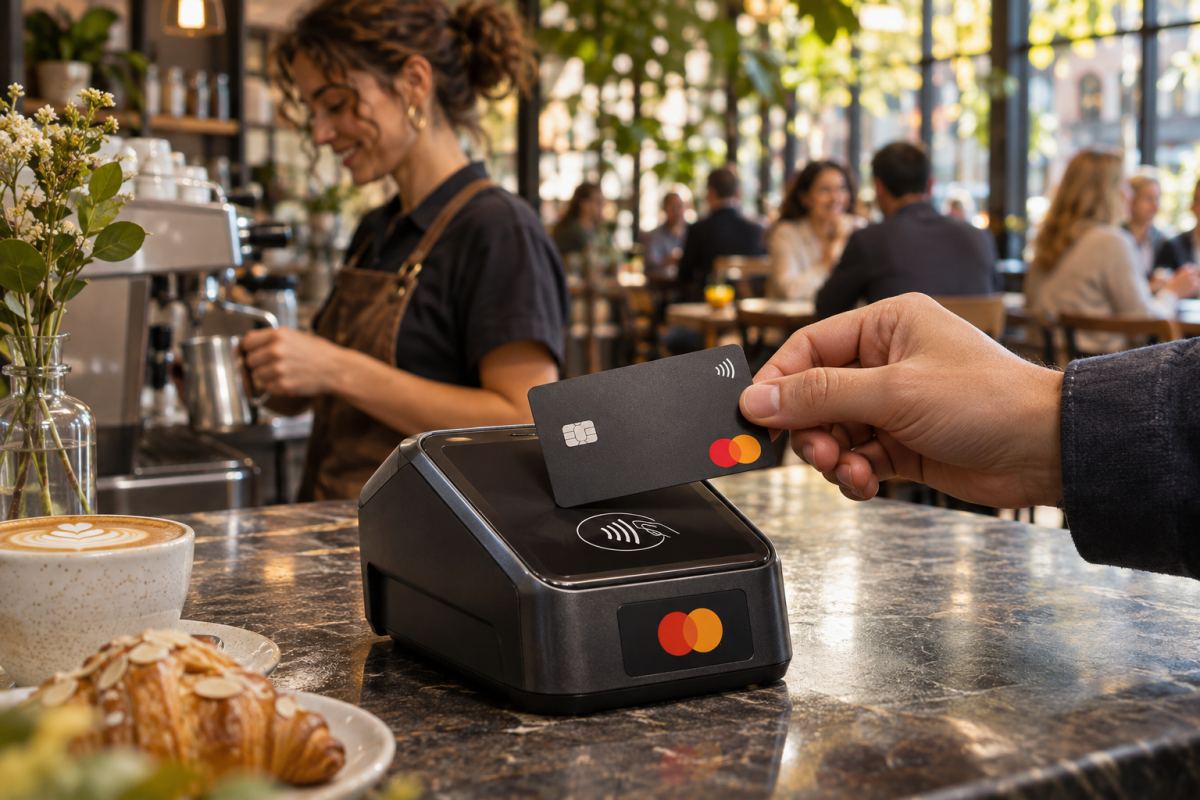
Mastercard's two overlapping circles appear at the moment of payment, but the company's commercial ambition extends well beyond that moment. A transaction can generate demand for identity checks, fraud detection, analytics and advice before and after money changes hands. Turning a global network into a wider services business is one of the central questions behind a company valued at approximately $571.42 billion in the November 5, 2026 market snapshot.
That value does not represent money deposited by cardholders. Mastercard operates a payment network and related services; banks and other financial institutions generally issue the cards and provide the credit. Understanding the division is essential to reading its income statement. The company earns fees from facilitating activity and supplying capabilities, rather than collecting all the interest that consumers pay on cards bearing its logo.
From a bank association to a public company
Its origins lie in the Interbank Card Association, formed in 1966 by banks seeking a shared framework for card acceptance. Rules for authorizing transactions, exchanging information and settling obligations allowed separate institutions to participate in a network that could become more useful as it expanded. International relationships followed, including links in Mexico and Europe and the admission of Japanese members in 1968.
The familiar Mastercard identity developed as that network crossed borders. A merger with Europay International in 2002 accompanied the conversion from a membership association into a private share corporation. Its 2006 initial public offering then gave stock-market investors a direct claim on the economics of a business originally organized around participating financial institutions. Class A shares trade on the New York Stock Exchange under MA.
That history still helps explain the company's relationships. Banks are customers and distribution partners, while merchants need reliable access to payments and consumers expect purchases to work without studying the underlying arrangements. Mastercard must maintain incentives for all those participants. Having a widely accepted brand gives it scale, but does not remove negotiations over price, routing, security or the allocation of costs among the institutions involved.
What the network actually sells
A typical card payment requires authorization from the issuer, clearing of transaction information and settlement between the relevant parties. Mastercard supplies network infrastructure and rules that help those steps work across institutions and countries. Some fees depend on spending volume, some on transactions and others on cross-border activity or additional services. An increase in the value of purchases is therefore related to revenue without being the same thing as revenue.
Interchange is another important distinction. It is generally paid between the acquiring and issuing sides of a transaction under applicable arrangements; it is not simply Mastercard's own sales. The company can still be deeply affected by disputes and regulation concerning payment costs. A network's economic exposure extends beyond the specific fees it recognizes in its accounts because changes in the wider system can influence acceptance, competition and customer behavior.
The scale is considerable. Mastercard reported $10.6 trillion of gross dollar volume and 175.5 billion switched transactions for 2025. Those measures capture different aspects of activity and should not be added together. Volume helps describe spending on branded programs, while switched transactions measure processing through its network. Neither is a pool of funds that Mastercard owns, and neither can be compared directly with a bank's deposits or loan book.
Services are becoming a larger part of the equation
Calendar 2025 net revenue was $32.791 billion, up 16%. Payment-network net revenue contributed $19.476 billion, while value-added services and solutions supplied $13.315 billion. The latter grew 23%, faster than the network business's 12%. Security, digital authentication, consumer engagement and business insights help explain why Mastercard's prospects depend on more than the number of times someone presents a card at a terminal.
Services can deepen customer relationships and diversify the sources of revenue. They can also require acquisitions, specialized staff and continuing technology investment. Not every service is independent of payment activity, and the annual report attributed part of the segment's growth to acquisitions. Treating the entire increase as organic growth, or assuming that services make the company immune to a consumer slowdown, would overstate what the figures establish.
Pricing must also be read after customer incentives. The payment-network net revenue figure for 2025 included $20.522 billion of rebates and incentives provided to customers, up 16%. That is a deduction already reflected in the reported net figure, not an expense to subtract from it again. The amount shows that competition for institutional relationships is substantial even in a business with strong network effects and a globally recognized brand.
High profitability, a different kind of balance sheet
Mastercard earned $14.968 billion in net income during 2025, with diluted earnings of $16.52 a share. Operating cash flow was $17.648 billion. This is a business capable of generating substantial cash without building a factory for every additional payment. Its economics nevertheless require resilient computing infrastructure, cybersecurity, customer investment and the ability to maintain trust when something goes wrong across a complex financial system.
Total assets at December 31, 2025 were $54.157 billion. That comparatively modest figure beside its market capitalization reflects the character of the business: a balance sheet records cash, receivables, acquired goodwill and other recognized assets, while a stock valuation incorporates expectations of future profits. Neither number measures the total spending supported by the network. A high market-to-assets ratio does not mean the company holds the difference as hidden cash.
By September 30, 2026, total assets had risen to $58.149 billion. Cash and equivalents were $10.147 billion, separately from restricted funds and customer security deposits. Short-term debt of $1.749 billion and long-term debt of $22.189 billion added up to about $23.9 billion. Restricted balances serve particular obligations; counting them all as freely distributable corporate cash would give an inflated picture of financial flexibility.
The latest results test the strategy
Third-quarter 2026 net revenue reached $9.807 billion, 14% above the year-earlier period. Net income was $4.628 billion and diluted earnings were $5.28 a share. Payment-network net revenue increased 11%, and value-added services and solutions grew 19%. The figures point to continuing expansion in both activities, with the faster-growing services operation again helping the company's overall revenue trajectory.
The underlying drivers were more measured than the revenue increase. Gross dollar volume grew 7% in local currencies to $3.0 trillion, cross-border volume rose 11% on the same currency basis and switched transactions increased 9%. Pricing and the mix of activity also influence the result. Meanwhile, payment-network rebates and incentives grew 18%, illustrating why stronger payment activity does not translate mechanically into an identical percentage increase in net revenue.
Chief executive Michael Miebach's task is to sustain that combination without weakening the network's core reliability. Digital wallets can make Mastercard less visible to the customer while still using its infrastructure. Other payment systems can compete for transactions or institutional budgets. The relevant question is which role the company retains in the payment, and what customers will pay for the additional security, information and services it provides.
Cash returns and the price of expectations
During 2025, Mastercard repurchased $11.727 billion of Class A shares and paid $2.756 billion in cash dividends, or $3.04 a share. In the third quarter of 2026 alone, it spent $3.0 billion buying 5.3 million shares and paid $763 million in dividends. Repurchases can increase each remaining share's claim on earnings, but the benefit depends partly on the price paid and should be distinguished from growth in the business itself.
The November 5 equity valuation was about 38 times reported 2025 net income, a historical comparison rather than a forecast earnings multiple. That price asks investors to place considerable weight on future growth and durability. Litigation, payment regulation, cyber incidents, customer bargaining and alternative payment methods can all affect the outcome. A globally embedded network can be an excellent business and still present a demanding valuation question.
Mastercard's distinctive challenge is to make its network more valuable without assuming that every adjacent service will inherit the same advantages. The company has the transaction relationships, cash generation and technical reach to pursue that expansion. Its long-term result will depend on whether customers continue to see measurable value in the services wrapped around a payment, while the underlying act of paying remains dependable, competitive and easy.