Costco’s Real Power Is the Bargain Its Members Keep Renewing
Membership, a limited assortment and fast-moving inventory underpin the warehouse model. Its history and latest financial results explain the discipline behind growth and a demanding stock valuation.
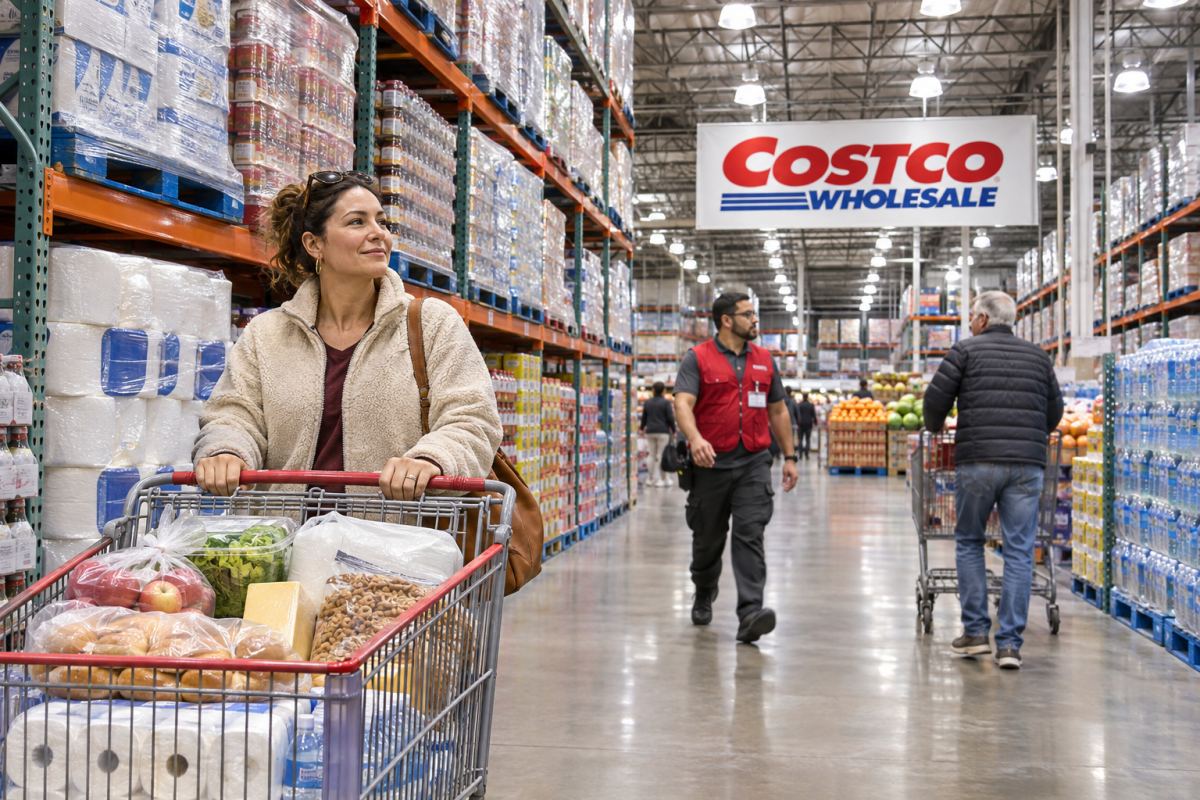
Costco asks customers to pay before they become regular shoppers. That membership fee changes the relationship: people expect the savings from returning to justify the cost of belonging. The company's success depends on delivering enough value to renew that bargain year after year. Its warehouses, purchasing scale and limited assortment support an economic model built around frequent purchases and trust in the prices on offer.
The stock market valued Costco at approximately $472.19 billion on November 5, 2026. Behind that valuation is a retailer with large sales and a comparatively small net margin, rather than a high-margin software business. Understanding why investors attach such value to it requires looking at membership renewal, inventory movement, supplier terms and the discipline needed to expand without weakening the proposition that brings customers back.
Two warehouse histories became one company
The model's roots include Price Club, which opened in a converted aircraft hangar in San Diego in 1976. It initially served small businesses before expanding its membership approach. Costco's own first warehouse opened in Seattle in 1983. The two businesses developed around a similar idea: combine volume purchasing and efficient operations with low merchandise markups and a recurring membership relationship.
Their 1993 merger created PriceCostco, with 206 locations and approximately $16 billion in annual sales at the time. The Costco name returned in 1997. Those milestones explain why its history includes both the earlier Price Club experiment and the growth of the separate Costco chain. The resulting company carried the warehouse-club model into more markets while preserving the importance of the member relationship.
Kirkland Signature, its private-label brand, adds another layer to that proposition. Products sold under a shared name can strengthen loyalty when customers trust their quality and value. They also give the retailer a distinctive offer alongside national brands. Maintaining that trust requires product standards and reliable suppliers; the commercial benefit of a strong private label comes with responsibility when a product disappoints or must be recalled.
Fewer choices can make the operating system stronger
Costco says its core warehouses carry fewer than 4,000 active stock-keeping units, far below the assortment offered by many broadline retailers. Limiting models, sizes and variations allows larger purchases of selected products and can simplify handling. The strategy asks shoppers to accept less choice in return for value. Buyers must choose well because a smaller assortment leaves each decision with greater influence on the shopping experience.
Merchandise often arrives on pallets and moves through straightforward warehouse facilities. Efficient distribution and rapid turnover reduce handling and support lower margins on each sale. The company says it often sells inventory before payment to suppliers is due. That timing can improve working capital: a retailer may receive cash from a member before paying for the goods that produced the sale.
The model still requires substantial assets. Buildings, equipment, distribution facilities and inventory must be financed and maintained. Labor, electricity, transport and product losses affect the economics even when the warehouse appearance is simple. Low merchandise margins make operating discipline particularly important. A modest change in costs can absorb a meaningful portion of profit unless volume, productivity or pricing offsets it.
Membership income is valuable, but it is not all the profit
For the 52-week fiscal year ended August 30, 2026, net merchandise sales reached $297.247 billion. Membership fees added $5.907 billion, taking total revenue to $303.154 billion. Keeping those measures separate avoids understating reported revenue or treating fees as merchandise sales. Net income was $9.226 billion, with diluted earnings of $20.76 a share, compared with $8.099 billion and $18.21 in fiscal 2025.
Membership fees are recognized over the membership period, rather than entirely when a customer pays. That accounting matches the ongoing right to shop with the period in which revenue is earned. The fee stream is attractive, but it is not a separately reported pool of pure profit. Warehouses, staff and other shared costs support the whole relationship, while merchandise itself also contributes to the company's economics.
Operating income of $11.685 billion exceeded membership-fee revenue in fiscal 2026, illustrating why the shorthand that all profit comes from fees is incomplete. Net income represented about 3% of total revenue. Such a margin can still produce substantial dollars when sales are enormous and inventory moves efficiently. Its durability depends on keeping enough value with members for the system to continue attracting their spending.
At fiscal year-end, renewal rates were 92.3% in the United States and Canada and 89.8% worldwide. These are trailing measures under Costco's disclosed methodology, rather than a real-time count of every member deciding that day. Even with that qualification, renewal is a crucial indicator. It reflects whether the company has delivered enough benefit for people to keep paying for access.
Expansion uses real capital
Total assets at August 30 were $89.045 billion, including $35.633 billion of property and equipment and $19.324 billion of merchandise inventories. Cash and equivalents were $20.207 billion, with another $1.094 billion of short-term investments. Those resources provide flexibility, while the stock-market valuation reflects expectations about future earnings far beyond the assets' carrying values.
Operating activities generated $15.817 billion in cash during fiscal 2026. Cash additions to property and equipment were $6.435 billion. New warehouses can increase membership and purchasing scale, but they require sites, construction, people and inventory before they reach maturity. Adding locations too close to existing stores can also redistribute sales within the chain. The economics depend on productive expansion, not the opening count alone.
The company operated 939 warehouses at the fiscal year-end, up from 914 a year earlier. By its November 4 sales update, the count had reached 943, including 651 in the United States and Puerto Rico and 115 in Canada. Japan had 37 and China seven. The dates matter: the larger current network should not be presented as the exact number operating at the August balance-sheet date.
International expansion tests how well the membership proposition travels. Product choices, real-estate conditions, customer habits and regulation differ across markets. A standardized operating philosophy can create efficiencies, while local buying and execution still determine whether customers see sufficient value. Foreign-exchange movements can also change reported growth even when the underlying business in a local currency develops differently.
The latest sales show momentum and measurement choices
The fourth quarter covered 16 weeks, longer than a standard 13-week quarter. Net merchandise sales were approximately $93.9 billion, up 11.2%, and net income reached $2.998 billion. Earnings included a nonrecurring benefit of $0.15 per diluted share from tariff refunds after partial reinvestment in member value. Treating that benefit as recurring trading performance would overstate the earnings available from simply repeating the quarter's operations.
The more recent October retail month, comprising four weeks ended November 1, produced $24.50 billion in net sales, 12.6% above the comparable period. Comparable sales rose 11.1% as reported and 7.3% after excluding gasoline-price and currency effects. Both measures are useful, but they describe different influences. New warehouse sales also help explain why total sales growth differs from comparable-location growth.
Digitally enabled sales rose 22.5% in that four-week period. Costco defines these as transactions initiated through a digital device, including some fulfilled through warehouses, distribution centers or Costco Travel. The measure therefore extends beyond a narrow definition of merchandise shipped from an online store. The challenge is to add convenience while preserving the cost and value advantages that members expect from the broader operation.
A dependable business can still carry demanding expectations
President and chief executive Ron Vachris leads a company whose COST shares trade on Nasdaq. During fiscal 2026, Costco paid $2.458 billion in cash dividends and recorded approximately $847 million of share repurchases under its repurchase-program disclosure. Debt consisted of $2.248 billion due currently and $3.914 billion classified as long term, separately from lease obligations. These commitments sit alongside continuing investment in the warehouse network.
The November 5 equity valuation was about 51 times fiscal 2026 net income, a comparison with completed annual earnings rather than a forward multiple. That places considerable weight on sustained growth and reliability. Competition, wage and freight costs, tariffs, product quality and new-market execution can all affect the result. Strong renewal rates support confidence, but do not eliminate the importance of the price investors pay for that confidence.
Costco's enduring asset is the commercial bargain it renews with members. Scale matters because it can improve buying terms; efficiency matters because it can help pass value through to shoppers. The company's next stage depends on preserving both as it builds more warehouses and digital services. Shareholders benefit when that discipline keeps customers renewing, inventory moving and cash generation strong after the cost of expansion.