Russia takes control of Tarkett and Ontex subsidiaries, increasing pressure on European companies
A decree places industrial assets under temporary management. Ontex confirms it has lost operational control of its Russian business, which accounts for about 5% of group revenue.
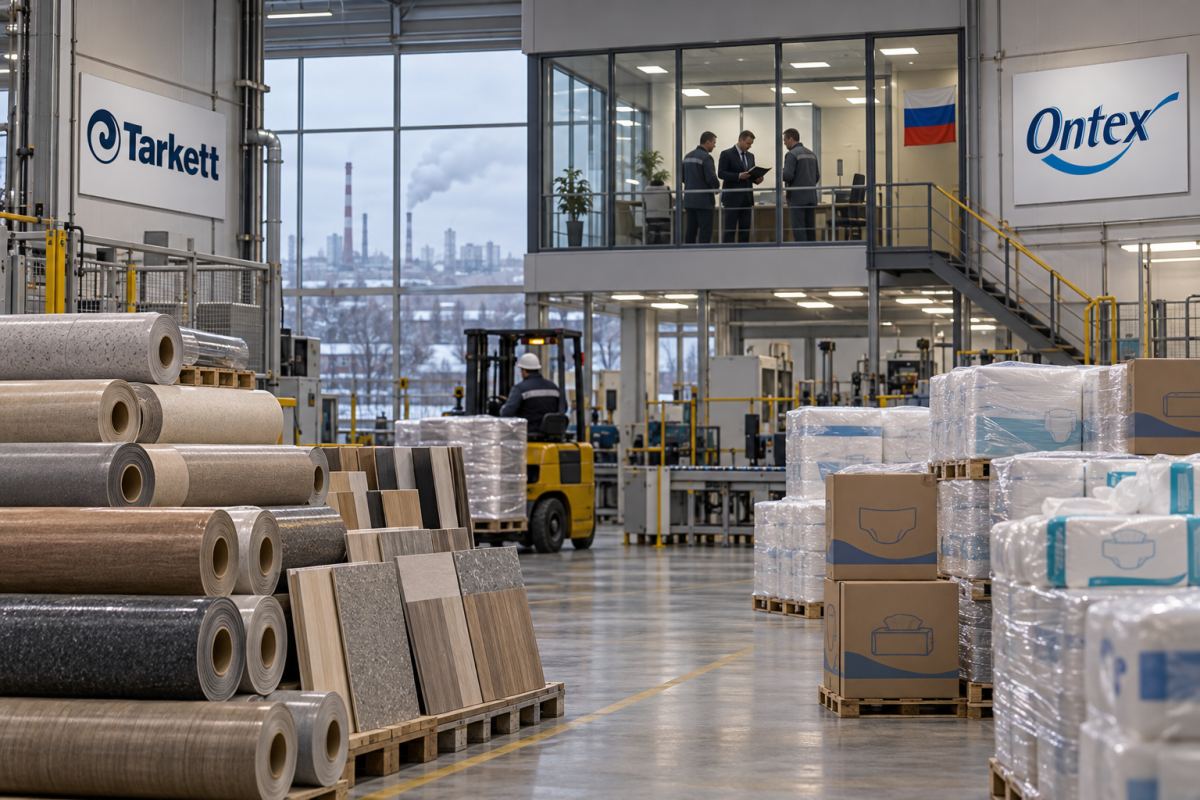
Russia has placed the local assets of several European groups under temporary management, including French flooring manufacturer Tarkett and Belgian hygiene products company Ontex. The decision, set out in a decree signed by Vladimir Putin and dated October 15, expands interventions targeting foreign companies that retain businesses in the country and adds pressure to the economic confrontation with Europe over the war in Ukraine.
Ontex confirmed on Friday that an administrator appointed by the Russian government had assumed operational control of its subsidiary. The measure affects the companies’ Russian operations, rather than their international businesses as a whole. For their parent companies, however, it creates an immediate problem: how to protect an investment whose day-to-day decisions are no longer in their hands.
From flooring to hygiene products
The list of affected companies shows that the intervention spans consumer and industrial activities. According to details of the decree reported by Reuters, it includes assets belonging to Tarkett, German packaging manufacturer Menshen, Sweden’s Sverige International Holdings and Ontex. It also covers Russian assets of Eviosys, the metal packaging business acquired by US group Sonoco in December 2024, which are held through a Dutch subsidiary.
That last distinction matters when identifying the owners: the involvement of a company registered in the Netherlands does not make Sonoco a Dutch business. These groups’ international structures allow an investment to be held through a chain of companies in different countries, while the affected operations remain in Russia.
Meduza reported that management was being handed to Tsentr Kapital. Among the Russian companies included, it identified Ontex Ru and packaging manufacturers Kappa Rus, Menshen Packaging CIS and Eviosys Packaging Kuban. In Tarkett’s case, the outlet noted that it has two factories in the Moscow and Samara regions. The decision therefore affects operating facilities and businesses.
What Russia represents for Ontex
Ontex’s statement provides a measure of part of the business impact. Its Russian subsidiary employs about 350 people and operates a factory in Noginsk and a sales office in Moscow. It accounts for around 5% of group revenue and between 7% and 8% of adjusted earnings before interest, taxes, depreciation and amortization, or EBITDA.
The company said Russia’s contribution to its cash flow was limited. Revenue, operating profit and cash available to the parent company are different measures: a subsidiary can make sales and generate earnings without transferring an equivalent amount of cash to the group. That distinction will matter when assessing the consequences of the loss of control.
Ontex said it was examining the situation and measures to protect its assets, business continuity and the interests of employees and other stakeholders. Its statement does not announce a factory closure or quantify a definitive loss. What has been confirmed is the change in operational authority; the full financial effects have yet to be determined.
The Kremlin links the move to the conflict with Europe
Russia’s explanation places these interventions in a political context. Business newspaper Vedomosti reported on Friday that presidential spokesperson Dmitry Peskov said the fact that the companies came from countries Moscow considers ‘unfriendly’ had been taken into account.
Peskov linked that position to Western actions involving Russian assets. This is the Kremlin’s argument for justifying the decision, rather than a legal conclusion shared by the parties. Reuters noted that Russian authorities have described these measures as reversible and linked them to European support for Ukraine.
The word ‘temporary’ does not, in itself, resolve the business uncertainty either. The announcements examined provide no timetable for restoring control. In the meantime, a parent company needs to clarify who can run its subsidiary and what access to information about its operations it will retain before presenting a definitive assessment to shareholders.
Two overlapping asset disputes
On the other side of the conflict are Russian funds immobilized in Europe. The Council of the European Union puts the value of Russian central bank assets blocked within the EU following the 2022 invasion at around €210 billion. The European framework allows the extraordinary revenues they generate to be directed toward mechanisms supporting Ukraine.
These are central bank reserves, a different category from the private industrial investments now affected in Russia. There is also a distinction between keeping capital immobilized and using the returns it generates. Grouping all these operations under a single label obscures which assets are in dispute and what decision has been taken about each.
The latest intervention follows similar measures against Nestlé, Auchan and Metro businesses in September. This succession of actions makes remaining in Russia a question that extends beyond sales or market share. For the affected groups, the next step will be to establish how much authority they retain over their subsidiaries and how the value of their investments changes. For their workers, the more immediate question is how operations will continue under the new management.