Hundreds of thousands join French strikes over pay and public services
The Interior Ministry counted 270,000 demonstrators outside Paris by 1 p.m. Trade unions and authorities reported different, partial turnout figures.
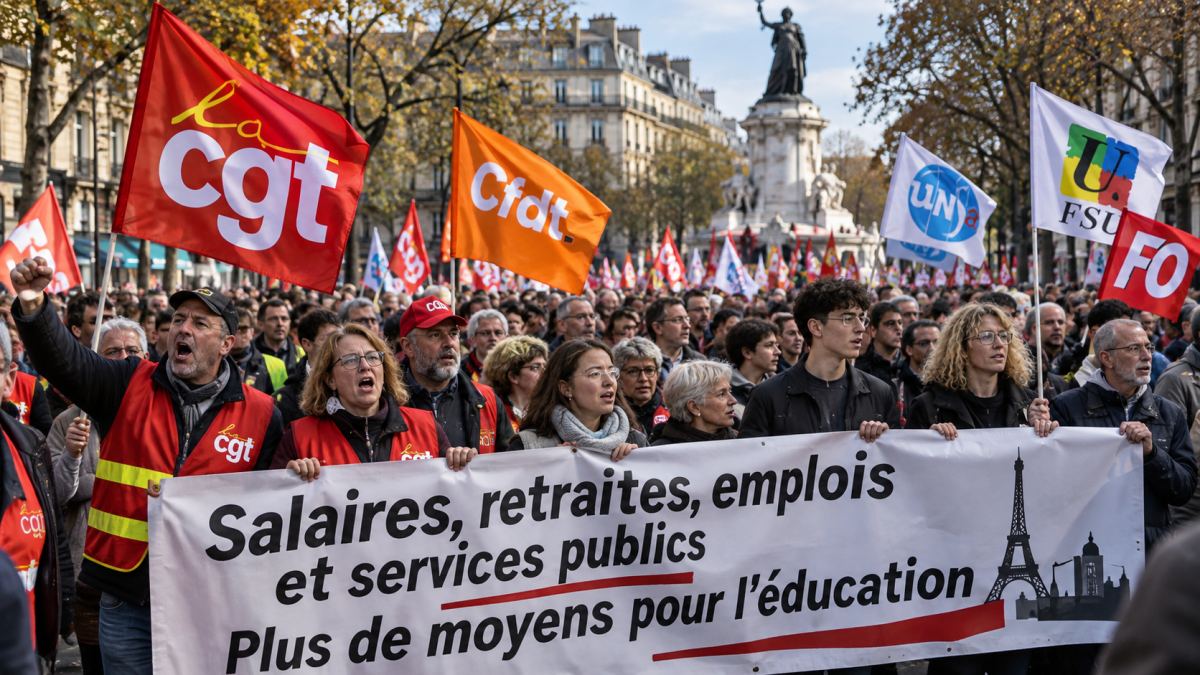
A day of strikes and demonstrations brought workers, students and pensioners onto the streets across France on Thursday to demand higher pay and more funding for public services, marking a new stage in a cost-of-living protest movement that has put pressure on the government for weeks.
Officials close to Interior Minister Laurent Nuñez estimated that 270,000 people had taken part in 180 marches outside Paris by 1 p.m., Le Monde reported. The CGT trade union federation counted more than 250,000 demonstrators in 73 cities at the same time. Both counts are partial, cover different areas and should not be added together.
In Paris, the march set off at about 2 p.m. from Place de la République toward Place de la Nation. Demonstrations also took place in Lyon, Marseille and other cities. Several trade union federations backed the action, which came as protests by secondary school and university students continued.
Pay and public services at the heart of the protest
The CFDT, CGT, Force Ouvrière, UNSA and FSU called the cross-sector action to demand improvements in pay, pensions, employment and public services. Their appeal also supported young people's right to demonstrate and called for better conditions in education.
Their shared demands include increases in the minimum wage and certain welfare benefits, company-level pay negotiations and higher pay for public employees. Each organization also has its own proposals for funding and implementing those measures.
CFDT general secretary Marylise Léon told Le Monde during the Paris march that her organization was seeking a €100 increase in monthly take-home pay for minimum-wage workers. She said the government must respond to workers' needs. The union's proposal is not an approved government measure.
CGT general secretary Sophie Binet, meanwhile, called for negotiations to raise wages and proposed attaching conditions to public aid for companies. The discussion comes amid France's budget debate and after weeks of protests by young people and other groups over rising living costs.
The Paris march and local turnout estimates
The Paris route between République and Nation was authorized after the prefecture rejected the unions' original request to march from Bastille to Concorde on security grounds. Before setting off, participants observed a minute's silence for the victims of the racist attack in Trappes and La Verrière, according to Le Monde's coverage.
The newspaper described a peaceful start and large crowds on Boulevard Voltaire. Demonstrations were still underway during the afternoon, and no final national figures for attendance or incidents were available at the time of reporting.
In Lyon, the prefecture estimated turnout at 30,000, while the joint union group put it at 55,000, Le Monde reported. In Marseille, the Bouches-du-Rhône prefecture counted 14,000 participants in the local march. The figures come from different sources and reflect the recurring gap between organizers' estimates and those of the authorities.
Uneven disruption to schools and transport
The Education Ministry said at midday that 15.81% of teachers had joined the strike, according to Le Monde. The figure was 19.14% in preschool and primary education and 13.53% in secondary schools. The FSU, one of the organizations behind the action, gave a higher estimate for secondary education.
On the railways, SNCF's four representative unions called on their members to stop work. The company expected disruption to vary by service. In the Paris region, transport operator RATP forecast normal operations on most metro, bus and tram lines, with the stated exception of the RER B commuter rail line, according to Le Monde.
General forecasts do not establish whether an individual train ran or was canceled. Disruption varies by line and time, and operators recommend checking each journey.
A nationwide security deployment
The Interior Ministry announced the deployment of 70,000 police officers and gendarmes and said more than 220 street actions were expected. Those figures describe the planned security operation and announced protests, rather than the number of demonstrators or a final assessment of the day.
The government said it aimed to secure authorized marches after unrest during earlier days of protest. Organizers, for their part, have called for the right to demonstrate to be respected. Disagreement over march routes had become a source of friction in Paris before Thursday's protest.
The day's demands are not identical across all groups: unions emphasize incomes and working conditions, students also seek changes in education, and the yellow vest movement maintains its own calls for action against inequality. As the afternoon continued, authorities and organizations were due to complete their respective turnout counts and assess the impact of the strike.