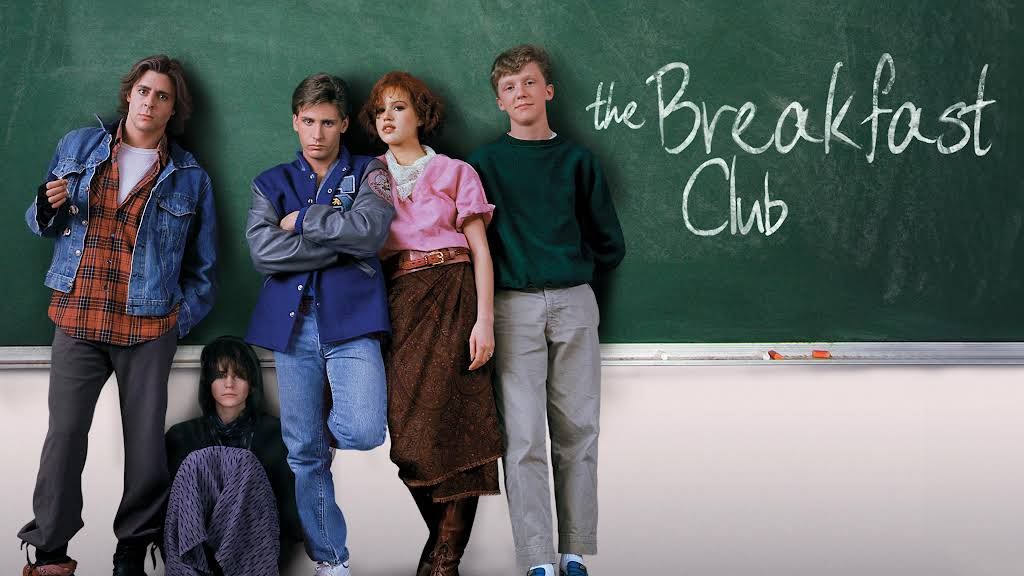

The teenagers in The Breakfast Club wanted adults to stop reducing them to labels. The actors who played them would spend much of their professional lives facing a similar problem. To millions of viewers, they remained the rebel, the popular girl or the conscientious student in that school library, even after they had moved into different work and found different audiences.
The Brat Pack was never a production company or an organization with an official membership. It was a name that gathered together several of the most familiar faces of American youth films in the 1980s. Four decades later, the familiar question—why did they disappear in the 1990s?—needs revising. Some lost leading roles, some built second careers and Demi Moore reached her greatest commercial prominence in that very decade.
Their story is less a simultaneous collapse than a series of attempts to grow older in front of an audience that preferred to remember them young. The movies kept circulating. The actors’ lives stopped moving together.
A magazine label becomes an identity
David Blum coined the name in a New York magazine article published on June 10, 1985. Emilio Estevez, Rob Lowe and Judd Nelson were central to the piece. Its play on the Rat Pack carried an unflattering word: brat.
The group that settled into popular memory was narrower than the original article’s field of young actors. Eight names are most commonly associated with it: Emilio Estevez, Rob Lowe, Demi Moore, Andrew McCarthy, Molly Ringwald, Ally Sheedy, Judd Nelson and Anthony Michael Hall. There was no membership card, and lists differ. Jon Cryer, James Spader and Lea Thompson belong to the surrounding network of films and collaborators; their inclusion depends on how the label is being used.
McCarthy experienced it as a put-down. In his memoir, he recalled being absent from the night out behind the profile, yet becoming attached to its collective image. That recollection is evidence of how he felt. It is not proof that one article destroyed eight careers.
He returned to the subject as director of the 2024 documentary Brats, built around conversations with former colleagues and Blum. The passage of time made room to revisit something viewers remembered affectionately and some actors remembered uneasily. A phrase could celebrate a generation while also making its members seem frivolous.
The films behind the phenomenon
Two 1985 movies anchor the Brat Pack’s image. John Hughes wrote and directed The Breakfast Club, bringing together Ringwald, Hall, Estevez, Sheedy and Nelson as five students serving detention. Its familiar social types move toward one another through talk about family, fear and the pressure to fit in. The small setting gives weight to people who begin by judging each other and gradually learn to listen.
Joel Schumacher’s St. Elmo’s Fire follows recent college graduates instead. Estevez, Lowe, Moore, McCarthy, Sheedy and Nelson appear alongside Mare Winningham. Work, relationships and responsibility can no longer be postponed until graduation. The movement between the two movies anticipates a challenge their actors would face: finding an adult identity after being sold as youthful promise.
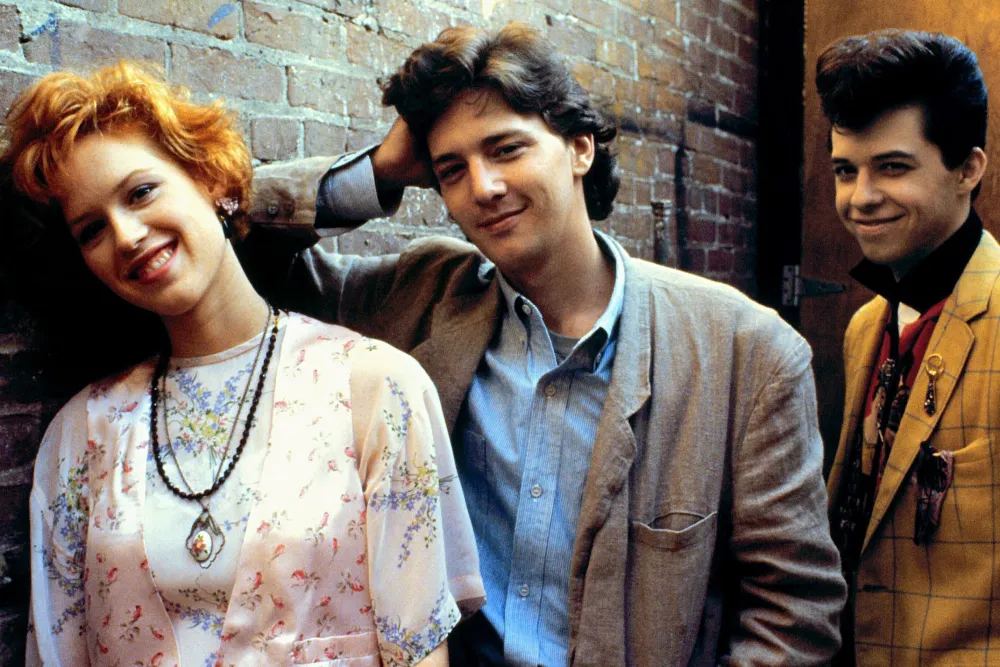
The broader picture includes Sixteen Candles (1984), which made Ringwald an instantly recognizable face of teenage movies, and Pretty in Pink (1986), with Ringwald and McCarthy. The latter was written by Hughes but directed by Howard Deutch. Treating every film from this cycle as a Hughes directing credit obscures how it was made. Its romance is divided by class, a boundary expressed through clothes, friendships and assumptions about who belongs with whom.
Hall was also closely associated with Weird Science (1985). Lowe had arrived in the cycle through Francis Ford Coppola’s The Outsiders (1983). McCarthy added Mannequin and Less Than Zero, both released in 1987. These are not all the same kind of movie, and their casts cannot simply be converted into a Brat Pack membership list. Together they offer contrasting pictures of growing up: school insecurity, social ambition, romance and darker encounters with adulthood.
Music and fashion helped preserve the memory. The stories’ continuing interest also lies in recognizable questions: where do I belong, how much does my family decide for me, what does money change, and what happens to friends when their lives diverge? That reading can explain the films’ appeal without making every convention they used admirable.
Why the group stopped dominating
The first change was unavoidable: the actors grew up. A character that made someone famous could make audiences reluctant to accept another side of them. Recognition helped attract attention, but attention fixed on one role could become restrictive. That tension did not affect every actor equally, and it cannot explain every casting decision.
Their common ground also broke apart. Careers moved into family films, comedy, television, independent productions and directing. Counting subsequent studio leads tells part of the story. It does not establish how much someone worked or whether they found work better suited to their interests.
The participants’ accounts describe different problems. Lowe has spoken about recovery as a turning point. Sheedy has discussed finding fully developed roles for women. McCarthy found room behind the camera and on the page. To explain all eight careers through a shared lack of talent, the same addiction or an industry-wide ban would impose a cause the evidence does not establish.
Memory introduces another distortion. When an entire generation is represented by two celebrated casts, it seems to vanish as soon as its members stop appearing together. The Brat Pack’s dispersal was real. Its supposed universal failure was not.
Demi Moore: the 1990s were an ascent
Moore provides the clearest reason to reconsider the premise. After St. Elmo’s Fire, she starred in Ghost (1990), A Few Good Men (1992) and Indecent Proposal (1993). Those were adult romances and professional or moral conflicts, not extensions of a teenage character. Her place in the 1990s cannot reasonably be described as a failure to escape the previous decade.
Her career was not an uninterrupted rise. Its interest lies partly in changing visibility and in the possibility of occupying a film’s center long after an initial period of stardom. The Substance (2024) gave her that position in a story about a woman pressured to replace her body with a younger version.
The performance brought her a Golden Globe in January 2025 and an Oscar nomination. On television, she plays Cami Miller in Landman and is included in the announced third-season cast. The relationship between Moore’s age and The Substance’s subject offers a revealing way to revisit the Brat Pack: an industry that markets youth must eventually decide what to do with the people who outgrow it.
Rob Lowe and Emilio Estevez: finding other audiences
Lowe moved beyond the young heartthrob through comedy and television. Wayne’s World, Tommy Boy and the Austin Powers films opened another register; The West Wing gave him Sam Seaborn, and Parks and Recreation gave him Chris Traeger. In a 2016 Television Academy interview, he described sobriety as a fundamental change in his life.
As of October 2026, his work includes hosting Fox’s The Floor. Keeping an audience does not require keeping the same character type or the same position on a movie poster. His career has crossed satire, political drama, television comedy and studio entertainment.
Estevez reached another audience as Gordon Bombay, the coach in The Mighty Ducks. He returned to the role in the first season of The Mighty Ducks: Game Changers in 2021. That return offered recognition without defining everything he had done since his youth-film years.
Directing became another part of his work. In The Public, commercially released in the United States in 2019, he acted and directed a story set in a Cincinnati library during extreme cold. Its social conflict concerns people seeking shelter and an institution deciding how to respond. It is a concrete example of changed interests, rather than evidence that a former teen star had stopped working.
Ringwald, Sheedy and McCarthy: widening the job
Ringwald remains inseparable from Hughes’s movies in many viewers’ minds, but her work did not freeze there. She played Joanne Carson in Feud: Capote vs. the Swans (2024) and translated Philippe Besson’s novel Lie with Me into English. An actor known for embodying teenage experience also brought a story of young love, desire and memory into another language.
Her distance from Hollywood also had a personal dimension. On Fresh Air in 2024, she recalled staying in Paris in her twenties because she was exhausted and uninspired. She described another form of typecasting: moving from teenagers to supporting mothers, with little room to drive the story.
Writing and translation suggest another measure: how widely her work developed, alongside how often she appeared as a film lead.
Sheedy found significant independent-film recognition with High Art (1998). More recently she played a mother in Single Drunk Female. Speaking to Salon in 2022, she said her most multidimensional roles had often come from women writers and producers. Her account describes the opportunities she encountered; it is not a universal explanation for other actors’ fortunes.
She also teaches. City College of New York identifies her as an instructor in acting for the camera. The image of the quiet young outsider in The Breakfast Club now coexists with a professional helping new performers learn the craft.
McCarthy moved into directing episodes of Orange Is the New Black and The Blacklist, among other series, and into travel writing. In March 2026 he published Who Needs Friends, an exploration of male friendship. Its subject returns to a question familiar from the old films: what happens to relationships when adulthood leaves less time to maintain them? His later work is not limited to revisiting the Brat Pack; it also follows interests beyond it.
Hall and Nelson: continuity without constant headlines
Anthony Michael Hall had an especially recognizable teenage image to leave behind. In 2024, he told TheWrap he had declined further Hughes projects to pursue a different direction and had struggled to find roles in his twenties. Unlike McCarthy, he said the label had scarcely mattered to him. Members of the same generation remembered it differently.
His subsequent work includes The Dead Zone and adult roles such as Tommy Doyle in Halloween Kills (2021). In Trigger Warning (2024), alongside Jessica Alba, he played Senator Swann. Between the boy in Hughes’s comedies and these characters lie changes in age and in dramatic function.
Judd Nelson also continued acting after the collective phenomenon faded. He appeared in New Jack City (1991) and maintained a film and television career. His later credits include Jane Spencer’s science-fiction film South of Hope Street (2024). A filmography less visible than Moore’s does not amount to retirement.
The useful distinction is between exposure and continuity. Viewers can lose sight of an actor without the actor losing all work. Nor does every subsequent role have to be promoted as a major comeback. A career can continue without an event that returns it to the headlines.
What survives youth
Returning to these films requires two perspectives. They preserve an era, but they also have limits: the young people they foregrounded did not represent every experience within their generation. Identifying with their conflicts does not require idealizing every behavior or treating everything once played for comedy as harmless.
Their lasting achievement lies in making recognizable characters who feared they would not be heard. Their actors’ lives add a second story. Some gained prominence, some changed audiences and some found different work within or beyond the screen. Understanding what happened to them means following those paths, rather than asking them to remain the young people of 1985.