ASML posts record sales as the AI boom runs up against factory capacity
The Dutch chip equipment maker warns that its planned capacity would fall short of demand in 2027 and 2028. Expansion takes time and construction.
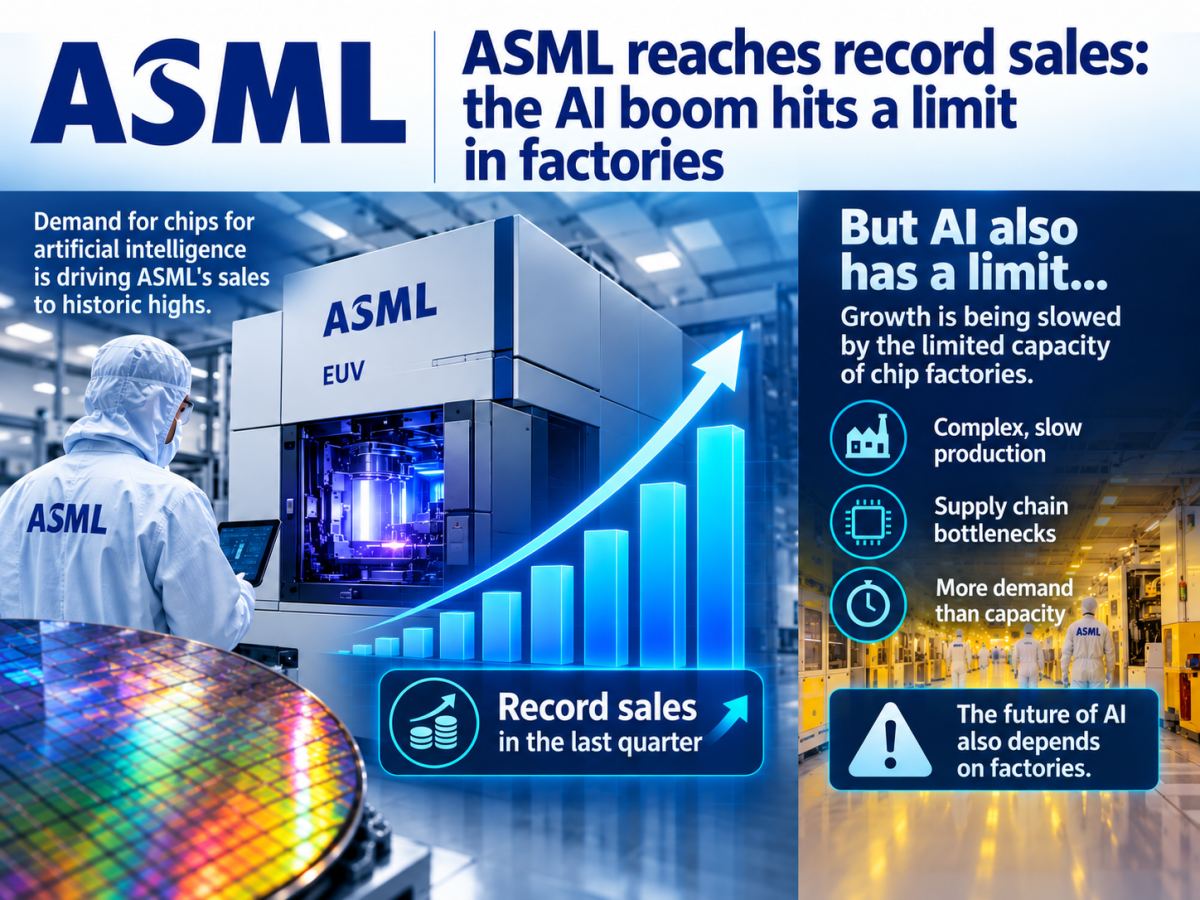
ASML reported record quarterly sales of €11.662 billion and net income of €4.960 billion in the third quarter of 2026. The figures, released on Wednesday, October 14, tell a story that extends beyond one company’s earnings: the momentum behind artificial intelligence is running up against the time needed to build the equipment used to make chips.
Christophe Fouquet, chief executive of the Dutch group, warned that its planned capacity for 2027 and 2028 would not meet all of its customers’ demand. The company is considering expanding it. This is a corporate forecast, still subject to decisions and execution, but it puts the problem in concrete terms: increasing semiconductor supply requires machines, facilities and an industrial supply chain capable of delivering them.
The factory behind the chip
ASML supplies lithography systems, one of the key tools in semiconductor manufacturing. It does not sell the finished processor installed in a phone or a server. Its equipment enables manufacturers to draw circuit patterns onto silicon wafers.
The company’s technical explanation helps clarify this step. Light carries a design from a mask, and an optical system reduces and focuses it onto a light-sensitive surface. The process is repeated to build the different layers. The outcome depends on the precision with which tiny structures are reproduced, alongside the many other processes needed to complete manufacturing.
That role makes lithography a link between the money flowing into new data centers and the physical capacity to build their components. Announcing an investment does not immediately put more chips into circulation. First, manufacturers must equip their plants and get their processes running reliably.
A comparison with the previous quarter shows the acceleration. In July, ASML had reported sales of €9.326 billion, net income of €2.918 billion and 86 new systems sold. These are figures from the preceding quarter, rather than a year-on-year comparison, and they show the jump from the immediate starting point.
Precision also depends on suppliers
Extreme ultraviolet technology, known as EUV, uses light with a wavelength of 13.5 nanometers. ASML explains that it is used for the most complex layers of advanced chips, while other layers continue to be made with deep ultraviolet systems. One technology does not automatically eliminate the need for the other.
EUV equipment must operate in a vacuum because even air absorbs this light. It uses specialized mirrors to direct it. Generating the light, positioning the wafers and keeping the entire assembly within extraordinarily tight tolerances requires several systems to work together. Expanding production is therefore a different challenge from increasing the number of software licenses.
The next generation, with a higher numerical aperture, aims to print smaller structures. That advance does not turn each machine into a complete factory: manufacturers must still integrate the equipment into their production lines, develop processes and verify the results. Confusing an improved tool with immediate chip production would exaggerate its effects.
Eindhoven: expansion has an address
Capacity growth also has a geographical dimension. On September 8, ASML began construction of a new industrial campus in Eindhoven, in the Netherlands’ Brainport region. The project would occupy approximately 350,000 square meters and could accommodate up to 20,000 workplaces over the long term.
The company’s official schedule calls for the first phase to be completed in 2029. That phase would have room for at least 3,000 employees, mainly teams relocating from existing facilities. It is therefore neither an announcement of 3,000 new hires nor a sign that the campus’s full potential is already available.
The design brings together production, logistics and supporting offices. ASML plans to reorganize the flow of materials and modules to operate on a larger scale. The aim is to gain capacity through industrial organization as well as additional floor space.
Local reporting reveals another part of the effort. On Tuesday, Omroep Brabant reported on work to widen an underpass beneath the A58 motorway between Eindhoven and Best. The project will provide space for cars, buses and bicycles and is intended to improve access to the area where ASML is expanding.
The regional story puts the expansion into perspective: a global industry needs local roads and transport. The project benefits other centers of activity in the area as well as the equipment maker. It also does not bring forward the completion date of the industrial facilities; these are separate construction projects with separate schedules.
Between projected demand and deliveries
Fouquet attributes the increase in his customers’ forecasts mainly to AI-related investment. Some are expressing interest in orders for 2029 and 2030. That interest should not be confused with revenue already earned or a guarantee that all those plans will materialize.
For the United States, Europe and Asia, the issue is shared: technological expansion depends on equipment and capabilities that cross borders. ASML’s earnings provide a sign of real activity, but the next test will be industrial. What matters now is whether expansion translates into machines delivered, and whether manufacturers can turn those deliveries into production within the time frames they promise.