Chevron’s Bigger Portfolio Must Turn Long-Lived Resources Into Lasting Returns
Hess adds another chapter to an energy company shaped by mergers and development. Its history, production mix, cash flows and shareholder commitments reveal the demands behind CVX.
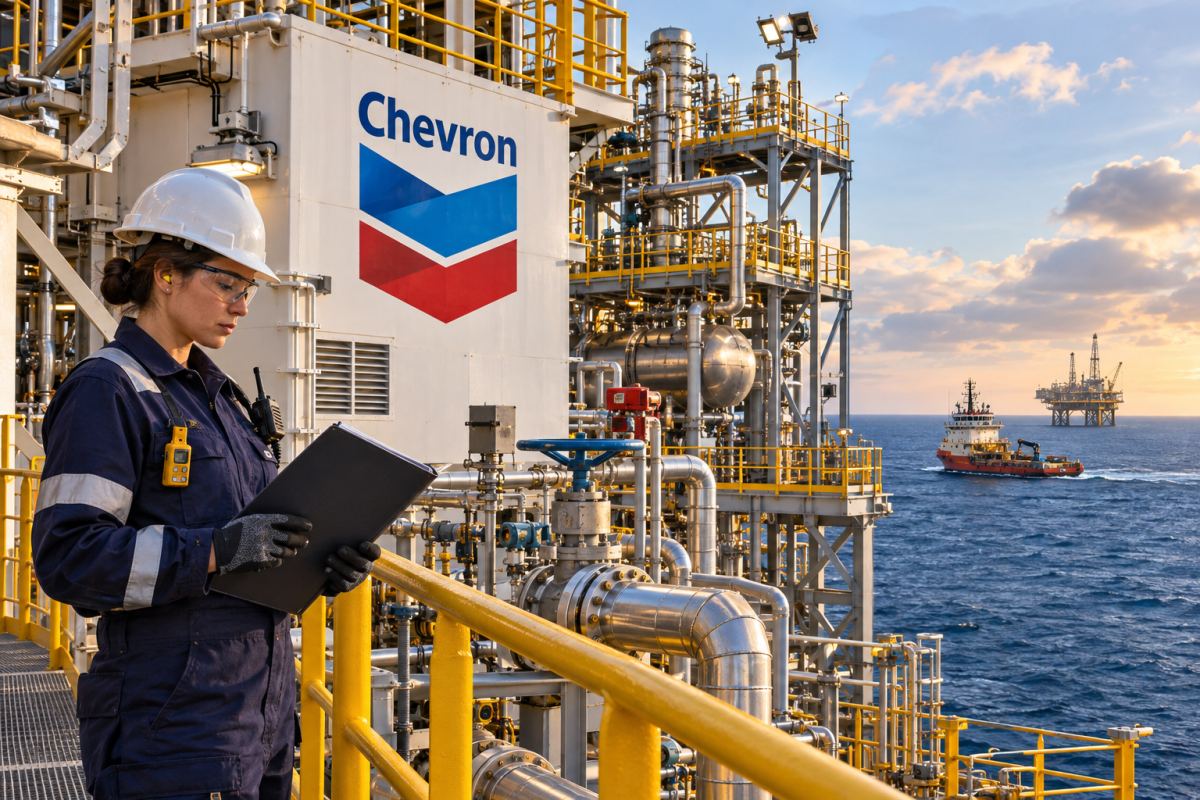
Chevron's future is being shaped by fields that take years to develop and transactions that can change its portfolio in a single reporting period. The completion of the Hess acquisition in July 2025 expanded its exposure to Guyana and the Bakken, adding another chapter to a company built through exploration, partnerships and mergers. The financial task is to turn that larger resource base into cash after development costs and shareholder commitments.
At approximately $415.42 billion in the November 5, 2026 market snapshot, Chevron's equity valuation reflected expectations about years of energy production. Oil and gas prices can move much faster than the assets producing them. The accounts therefore need to be read across different time horizons: a quarterly profit, a multiyear capital program and the economic life of a field do not describe the same thing.
A long history of changing the resource portfolio
Its origins date to Pacific Coast Oil in California in 1879. The business became part of Standard Oil before the industry's later reorganization, and eventually developed into the company now known as Chevron. Expansion depended on producing, transporting and refining hydrocarbons, creating an industrial network whose parts can earn very different returns as prices and demand change.
The 2001 merger with Texaco and the 2005 acquisition of Unocal broadened its international position and resources. Noble Energy followed in 2020, adding assets including the Eastern Mediterranean. These transactions show how the business has repeatedly combined existing operations with acquired positions. A purchase can improve the opportunity set, while its eventual value still depends on the price paid, the projects delivered and the cash generated.
Hess closed on July 18, 2025. It brought an interest in Guyana's offshore Stabroek development as well as U.S. assets. Chevron participates in Guyana through the acquired ownership interest; it is not the sole owner or operator of that development. Partnerships can provide access to attractive resources, while sharing control, investment decisions and the economics with other participants.
Production and refining earn money differently
The upstream business explores for and produces oil and natural gas. Its earnings respond to realized prices, production volumes, operating costs, taxes and the terms under which resources are developed. A high-quality field can generate cash over many years, but requires capital before and during production. Depletion also means the portfolio must be maintained or renewed if the company is to sustain output.
Downstream operations refine crude and sell fuels and other products. Their economics depend on the relationship between input costs and product prices, refinery performance and regional demand. A higher crude price does not automatically improve refinery profit. Integration gives Chevron exposure to several parts of the energy system, although it does not guarantee that one business will perfectly offset pressure in another.
The portfolio spans U.S. shale and offshore production, Kazakhstan, Australian gas and other markets. Different projects offer different development schedules, cost structures and political exposures. That variety creates flexibility while demanding coordination. The corporate result must also cover central financing and administrative expenses, rather than simply adding the most attractive field-level returns advertised for individual projects.
The annual accounts record the cost of expansion
For calendar 2025, sales and other operating revenue were $184.432 billion. Total revenue and other income, including equity-affiliate income and other items, were $189.031 billion. Net income attributable to Chevron was $12.299 billion, down from $17.661 billion in 2024, with diluted earnings of $6.63 a share. The two revenue measures should not be substituted for each other when comparing periods or other energy companies.
Year-end assets reached $324.012 billion, against $256.938 billion a year earlier. Net property, plant and equipment accounted for $219.729 billion. The Hess acquisition materially changed the balance sheet; the increase was not solely an organic buildup of equipment. Acquired oil and gas properties were recorded using estimates that depend on assumptions about prices, production, costs and risk, giving the accounting values an important forward-looking dimension.
Operating cash flow was $33.939 billion during 2025. Cash capital expenditure was $17.347 billion, leaving $16.592 billion under the company's free-cash-flow definition. That calculation helps show the resources remaining after direct investment, while acquisitions, asset sales, financing and other commitments also influence the overall movement in cash. Free cash flow is a useful measure with a specific scope, rather than a complete description of capital allocation.
Chevron paid $12.751 billion in common dividends and repurchased approximately $12.1 billion of shares under its program during the year. Combined, those distributions exceeded the reported free-cash-flow measure. That does not by itself identify a single funding source, but it makes the broader financing and portfolio picture relevant. A company cannot indefinitely assess distributions in isolation from investment and the strength of its balance sheet.
A strong quarter with lower worldwide output
Third-quarter 2026 total revenue and other income reached $67.798 billion, including $65.237 billion in sales and operating revenue. Net income attributable to Chevron was $9.924 billion, or $5.06 per diluted share, compared with $3.539 billion a year earlier. Adjusted earnings of $10.361 billion, or $5.28 a share, were a separate non-GAAP measure that excluded specified items.
Higher crude realizations and stronger refined-product margins helped drive the result. Worldwide net oil-equivalent production averaged 3.980 million barrels per day, below 4.086 million a year earlier. The combination is instructive: profit can rise sharply without an increase in global output when prices, margins and other conditions improve. Production growth alone is an incomplete explanation of an integrated energy company's earnings.
Upstream contributed $5.698 billion in quarterly earnings and downstream $4.931 billion. Other activities produced a $705 million net charge, reconciling the operating-area results with the corporate total. The large refining contribution demonstrates the importance of assets beyond the oilfield. It also reflects market conditions that should be evaluated as part of a cycle, rather than assumed to recur unchanged.
Operating cash flow reached $16.014 billion in the quarter, with capital expenditure around $4.0 billion. Chevron paid $3.482 billion in common dividends and spent $2.502 billion repurchasing shares. These actual quarterly payments differ from a newly declared future dividend. The board's $1.78-per-share distribution announced with the results was payable on December 10, making it a future payment as of November 5.
Financial flexibility depends on more than the oil price
At September 30, total assets were $333.786 billion and cash and equivalents $12.804 billion. Total debt had declined to $33.534 billion from $40.758 billion at the previous year-end. Stronger cash generation can help reduce financial obligations while supporting projects and shareholder payments. The durability of that flexibility depends on future prices and spending as well as operating performance.
Chairman and chief executive Mike Wirth oversees a company headquartered in Houston. Its plans include further development of acquired resources and continued work across existing operations. Delivering projects on time, controlling costs and maintaining safe, reliable facilities matter because capital is committed before the full return becomes visible. Delays and unplanned outages can affect both current output and the economics expected from earlier investment decisions.
The company also outlined plans for its Venezuelan joint ventures to invest $7 billion over five years. That is a prospective program, not a completed expenditure. International energy investments depend on contractual terms, government decisions, operating conditions and access to equipment and markets. Promising resources become valuable only when the arrangements and physical operations allow sustained, economic production.
The shares represent a continuing industrial obligation
Chevron's common shares trade on the New York Stock Exchange as CVX. Repurchases can increase the remaining shareholders' interest in future earnings, while dividends provide cash directly. Both have to coexist with replenishing productive assets. Comparing a dividend with accounting earnings alone can miss depreciation and cash-flow differences, but focusing only on a strong cash quarter can overlook the cost of the next investment cycle.
Longer-term demand and the energy transition add another horizon. The profitability of conventional production, lower-emission projects and new energy opportunities depends on customers, technology and policy. Commitments made today can operate for decades, so management must judge how useful those assets will remain under different conditions. A growing resource base is valuable when it can earn an adequate return after environmental, operating and financial obligations.
Chevron has repeatedly expanded by bringing new resources into a large industrial system. The Hess acquisition continues that history, while the latest results show how strongly prices and refining margins can influence cash generation. For shareholders, the enduring result will be the return left after developing the portfolio and maintaining financial resilience. The company owns long-lived opportunities; realizing their value requires disciplined decisions through changing energy markets.