Nobel economics prize 2026: how Hall and Woodford's research helps cushion economic crises
The two American economists are honored for studying how household and business decisions can inform policies to tackle inflation and recessions.
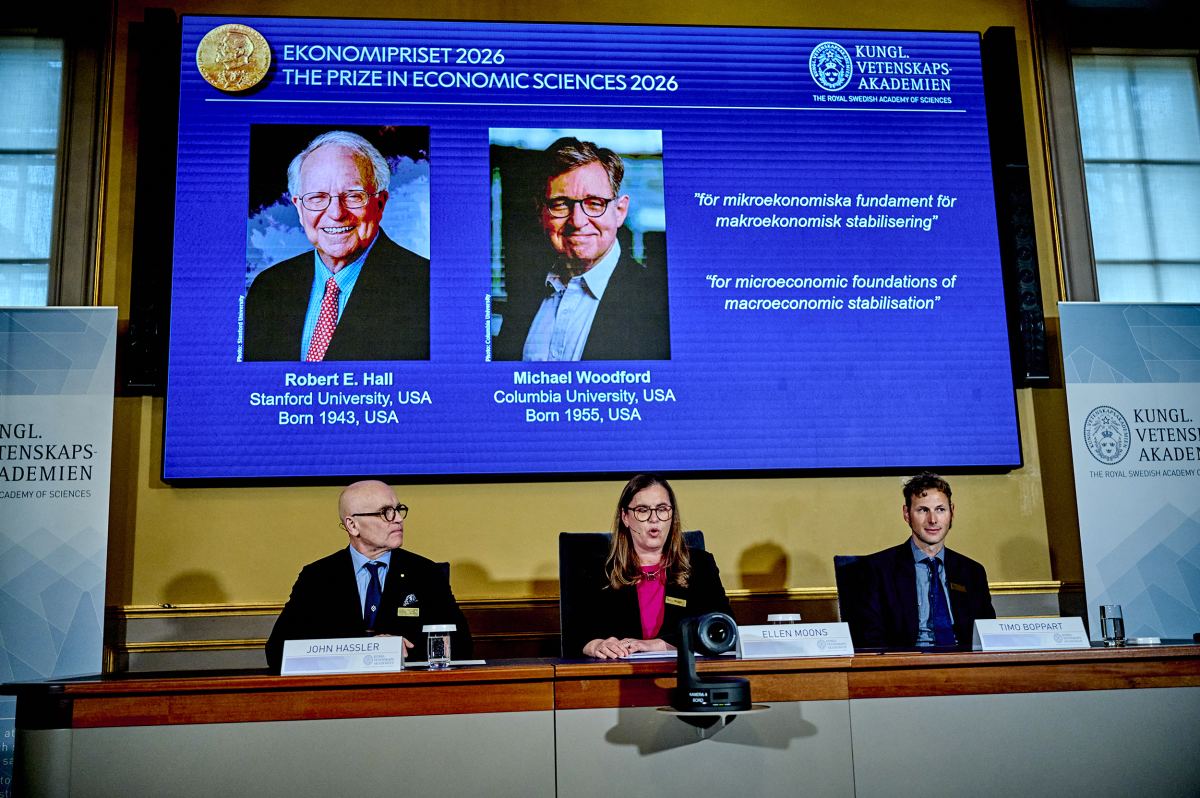
Robert E. Hall and Michael Woodford won the 2026 Nobel economics prize on Monday, October 12, for research that changed how economic crises are understood and addressed. The Royal Swedish Academy of Sciences recognized the Stanford and Columbia professors for developing the foundations of models that governments and central banks use to decide when to stimulate economic activity and when to slow it down.
The award, announced in Stockholm, carries a prize of 12 million Swedish kronor, to be divided equally. The official citation recognizes their contributions to the “microeconomic foundations of macroeconomic stabilisation.” Behind that technical phrase lies a familiar question: how can a rise in prices or a drop in consumer spending be prevented from turning into a deeper crisis?
Why they were awarded the Nobel
Hall and Woodford helped build an understanding of the economy that starts with the decisions of individuals and businesses. To understand how much a country consumes, it matters how each household decides to spend or save. To understand inflation, it is necessary to examine how businesses set their prices. Those decisions also look ahead: they depend on what people expect to earn, pay or sell in the future.
The Academy highlights how their research helped rebuild stabilization policy after the difficulties of the 1970s. The oil crises had exposed the shortcomings of models that could not adequately explain the combination of high inflation, unemployment and weak growth. Relationships observed in the past were not enough to determine what to do in a new situation.
Their contributions offer tools for assessing the consequences of policy intervention. Stimulating a depressed economy can help activity recover; doing so when prices are already under strong upward pressure can worsen inflation. The achievement recognized by the prize is a firmer foundation for studying those responses, incorporating the behavior of both those receiving the stimulus and those selling goods and services.
Robert Hall: spending also depends on what we expect
Hall was born in Palo Alto, California, in 1943. He graduated from the University of California, Berkeley, and earned his doctorate at the Massachusetts Institute of Technology, MIT, in 1967. He taught at both institutions before joining Stanford in 1978, where he is listed as an emeritus professor of economics.
His work spans employment, inflation, technology and competition. He served as president of the American Economic Association in 2010 and directed the National Bureau of Economic Research's Economic Fluctuations and Growth program from 1978 to 2013. He has advised institutions including the U.S. Treasury and the Federal Reserve. His work connects academic research with practical questions of economic policy.
A crucial contribution appeared in a 1978 paper on consumption. Hall showed that, under certain assumptions, changes in spending cannot be anticipated simply by looking at past income. If households already use the available information to plan their purchases and savings, a change in that plan depends on new information. The study tested the idea against U.S. data and found support for a modified version of the theory.
The logic can be seen in a family that knows it will receive additional income in a few months: that expectation can influence its decisions before the money arrives. Unexpected news about a family member's job, by contrast, may force a rethink. The present matters, but so does the outlook for future income.
That does not mean every household can behave in the same way. Those without savings or access to borrowing have less scope to spread their consumption over time. The difference helps explain why a policy that raises incomes can prompt different responses across households.
Michael Woodford: interest rates and credibility matter
Woodford was born in Chicopee, Massachusetts, in 1955 and earned his doctorate in economics at MIT in 1983. His education includes studies at the University of Chicago and a law degree from Yale. He is the John Bates Clark Professor of Political Economy at Columbia University in New York.
Before the Nobel, his honors included the Deutsche Bank Prize in Financial Economics in 2007, the Banque de France/TSE Prize in Monetary Economics in 2018 and the Erwin Plein Nemmers Prize in Economics in 2024. His recent research also examines how limits to reasoning and mental representation affect economic decisions.
His book Interest and Prices: Foundations of a Theory of Monetary Policy, published in 2003, brought together a framework for studying monetary policy. It examines how interest-rate rules can help stabilize the economy and prices, and what can be gained when authorities maintain credible commitments rather than treating each intervention as an isolated decision.
In that framework, prices and wages do not adjust instantly. If demand falls and a business holds its prices steady, it may sell less and cut production. Monetary policy can therefore affect real economic activity as well as inflation. The model makes it possible to examine which response would be appropriate and which objectives might come into conflict.
Communication is also part of policy. Today's decisions are shaped by the interest rates and inflation expected tomorrow. A consistent explanation of what a central bank will do helps guide those expectations; promises that subsequently lack credibility weaken that ability. For a household or a business, what matters is not only today's borrowing cost but also the cost it expects to face over the coming years.
A prize established in 1968 and presented in Stockholm
The award commonly called the Nobel economics prize has a different history from the five original prizes established by Alfred Nobel. Its official name is the Sveriges Riksbank Prize in Economic Sciences in Memory of Alfred Nobel. Sweden's central bank established it in 1968 to mark its 300th anniversary, and it was first awarded in 1969 to Ragnar Frisch and Jan Tinbergen.
The Royal Swedish Academy of Sciences selects the laureates. The announcement is made in October, and the award is presented in Stockholm on December 10, the anniversary of Nobel's death. Economic sciences shares the Swedish ceremony with physics, chemistry, medicine and literature; the Nobel Peace Prize is presented in Oslo. The original prizes were first awarded in 1901.
This year's recognition honors an approach to studying crises whose findings help inform decisions affecting millions of people. It does not turn models into a guarantee against recession or prescribe the same response for every country. Their value lies in better understanding the responses of households and businesses before deciding how much to stimulate or restrain the economy.