Samsung Electronics: The Memory Boom Behind a Familiar Consumer Brand
Chips and finished devices follow different economic cycles inside Samsung. Its history, balance sheet and extraordinary latest results reveal the opportunity and volatility shareholders must understand.
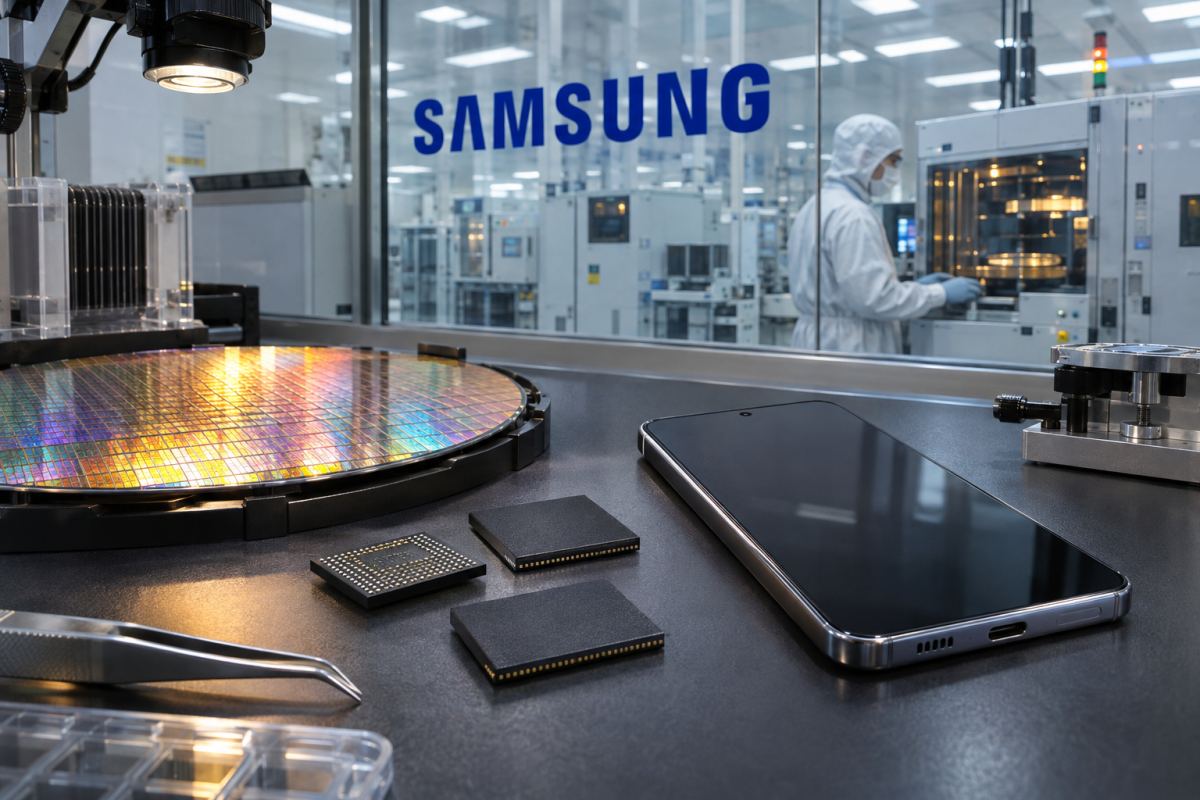
The Samsung name appears on phones and televisions, but its most consequential products are often hidden inside other equipment. Memory chips, displays and semiconductor manufacturing services connect Samsung Electronics to competitors as well as consumers. That combination gives the South Korean company unusual reach: it can sell a finished device while supplying components to businesses competing for the same customer.
In the November 5, 2026 market snapshot, Samsung Electronics had an equity value of approximately $932.67 billion. This refers to the listed electronics company, not the entire Samsung group. Its accounts are reported in Korean won, making it important to keep operating results in their original currency rather than compare a dollar market value directly with an unconverted balance-sheet figure.
From consumer electronics to the foundations of computing
Samsung Electronics was incorporated in 1969 and listed in South Korea in 1975. Its identity developed through the manufacture of consumer products and an expanding commitment to electronic components. Over time, expertise in making devices became intertwined with expertise in producing the parts inside them. The current company is the result of that industrial development, rather than a smartphone business with a small chip operation attached.
The distinction matters because the two sides obey different economic rhythms. A handset manufacturer launches products, manages distribution and competes for consumer attention. A memory producer commits large sums to fabrication facilities before knowing exactly what prices those factories’ output will command. Both activities require technical execution, but their exposure to product cycles and industrial capacity differs substantially.
Samsung’s operating structure makes that dual identity visible. Device eXperience, or DX, covers finished products, while Device Solutions, or DS, contains semiconductor activities. Displays and Harman add further businesses. Young-Hyun Jun leads DS as a chief executive, and Tae-Moon Roh leads DX as a chief executive. Their parallel responsibilities reflect an organization managing more than one kind of technology competition.
The annual business before the latest surge
For the year ended December 31, 2025, Samsung Electronics reported consolidated revenue of 333.606 trillion won and operating profit of 43.601 trillion won. Consolidated net income was 45.207 trillion won, including 44.261 trillion attributable to owners of the parent. Operating profit and net income differ because financing, investment results and taxation sit outside the main operating calculation.
The scale of the finished-products operation should not be overlooked. DX reported annual segment revenue of 187.967 trillion won, while DS reported 130.128 trillion. These segment figures cannot simply be added to displays and Harman to obtain consolidated sales: internal transactions must be eliminated. A component supplied within the group is not a second sale to an external customer.
DS generated 24.858 trillion won of operating profit in 2025, against DX’s 12.853 trillion. Even before the extraordinary latest quarter, semiconductor operations were central to earnings. A familiar consumer brand can therefore give a misleading impression of the company’s profit mix. The products most visible in a shop are not necessarily the activities making the largest contribution to consolidated returns.
The year-end balance sheet contained 566.942 trillion won of assets, including 215.305 trillion of net property, plant and equipment. That physical investment distinguishes Samsung from technology businesses that mainly license software or outsource production. Fabrication plants and other facilities create capabilities competitors cannot reproduce instantly, but also expose the company to depreciation, utilization and the need for continual reinvestment.
A memory boom changes the earnings picture
The latest reported quarter as of November 5 ended September 30, 2026. Samsung reported revenue of 195.3 trillion won and operating profit of 107.4 trillion. These were quarterly results, not annual totals. Their scale represented a dramatic change from the previous year’s full-year accounts and made the source of the improvement essential to understanding the company’s position.
DS generated 147.1 trillion won in quarterly revenue and 106.5 trillion in operating profit. Samsung attributed the memory business’s improvement to higher market prices, constrained supply and demand associated with artificial intelligence. The company also reported expanding sales of HBM4, a high-bandwidth memory product. AI computing needs fast access to data as well as processors, giving memory an important role in infrastructure spending.
Those conditions explain the opportunity without guaranteeing that the same margins will persist. Memory markets respond to supply, inventory and investment decisions across the industry. Higher prices can encourage capacity expansion, while customers may change purchasing plans. A strong quarter demonstrates what existing assets can earn under favorable conditions; it does not establish a permanent level of profitability for every future period.
The contrast with finished devices was sharp. Mobile eXperience and Networks together reported revenue of 37.7 trillion won and an operating loss of 0.6 trillion. Visual Display and Digital Appliances reported revenue of 13.9 trillion and a 0.2 trillion operating loss. Rising component and other costs can therefore benefit one part of the broader technology chain while placing pressure elsewhere.
Samsung Display reported operating profit of 1.1 trillion won for the quarter. Harman’s improved earnings included a benefit from nonrecurring US tariff refunds. These details matter when assessing diversification. Different businesses can soften or complicate the group’s exposure to a single market, but their profit contributions vary, and a temporary benefit should not be mistaken for recurring operating improvement.
Cash, factories and the next manufacturing decision
At September 2026, total assets had reached 791.842 trillion won, including 234.009 trillion of property, plant and equipment. The earnings presentation reported 214.823 trillion won in a broad cash category that includes short-term financial instruments and related holdings. It should not be described as cash in bank accounts alone. Debt was 17.191 trillion won on the presentation’s stated basis.
Operating cash flow for the quarter was 98.6 trillion won. Cash purchases of property and equipment were 26.9 trillion, while Samsung separately reported quarterly capital expenditure of 29 trillion, predominantly in DS. These measures follow different timing and classification conventions. Both underline the industrial scale of the company, but subtracting or substituting one for the other without explanation would blur the accounts.
The company also operates a foundry business, manufacturing chips for outside customers, alongside its own semiconductor products. Winning such work depends on process technology, production yields, reliability and customer confidence. Advanced manufacturing capacity is valuable only if it can deliver chips meeting customers’ requirements economically. Announcing a new process or a facility is consequently a different achievement from achieving sustained profitable output.
This structure brings strategic tensions. Samsung can draw on expertise across components and devices, but outside customers may also compete with its finished products. It must allocate capital among memory, foundry, displays and consumer businesses with different prospects. The most attractive recent earnings stream does not automatically justify directing every additional unit of investment toward the same activity.
What owners of Samsung shares receive
Samsung Electronics has common shares listed under 005930 and preferred shares under 005935 in South Korea. The share classes have different rights and market prices; a quote for one is not interchangeable with the other. International investors also need to consider currency movements, because changes in the won can alter the value of a Korean investment measured in another currency.
For the third quarter, Samsung declared a dividend of 4,601 won for each common and preferred share, totaling approximately 30 trillion won. This declaration is distinct from cash dividends already paid during the quarter. Management estimated total shareholder returns for 2026 at 90 trillion to 110 trillion won; that range was a plan, rather than a completed annual distribution.
Large distributions can make industrial success tangible for shareholders, but they compete with future investment needs. Semiconductor facilities are expensive, technology advances quickly and demand can shift. A balance sheet strengthened by an exceptional memory market provides options; using those options well requires separating temporary pricing strength from durable competitive advantages in manufacturing and product design.
Samsung Electronics connects the devices consumers recognize with the infrastructure enabling modern computing. Its history and latest results show both the strength and the volatility of that position. For shareholders, the central question is how much of the current earnings surge can become lasting cash generation through the next investment cycle, while the company restores stronger returns in its more visible consumer businesses.