Micron’s Memory Windfall Faces the Hardest Test: Making It Last
AI demand and advanced memory have transformed Micron’s earnings. Its industrial history, customer contracts and investment plans show what could strengthen the business beyond an exceptional year.
Artificial intelligence needs more than fast processors. Data must be stored, retrieved and delivered quickly enough to keep those processors working. That requirement has transformed the economics of Micron Technology, a memory manufacturer whose latest results bear little resemblance to the modest margins often associated with commodity chips. The opportunity is striking; deciding how much of it can last is the harder question.
Micron’s equity value was approximately $742.65 billion in the November 5, 2026 snapshot. Its business remains rooted in physical production, specialized engineering and large investment decisions. The company is trying to strengthen its position through advanced products and longer customer commitments, while operating in an industry where pricing and capacity have historically produced powerful swings in profits.
A Boise startup survives an unforgiving industry
Micron began on October 5, 1978, as a four-person semiconductor design business in the basement of a Boise, Idaho dental office. Its first contract involved designing a 64K memory chip. The company shipped its first manufactured 64K DRAM product in 1981 and became publicly traded on Nasdaq in 1984. Its early development joined circuit design to the difficult task of operating a factory.
The distinction shaped its future. Designing a chip establishes what it should do; manufacturing determines how many working chips can be produced from a wafer at an acceptable cost. In memory, improvements in density, yields and processing can change competitiveness across enormous volumes. Technical progress must therefore become repeatable industrial output, rather than remain a successful laboratory demonstration.
Consolidation also helped build the present company. The July 2013 acquisition of Elpida and a Rexchip stake expanded Micron’s capabilities and manufacturing reach. Its operations now extend across several countries, rather than being confined to the United States. Production, research, assembly and testing form an international system exposed to local conditions, trade rules and the practical demands of coordinating technology transitions.
Under chairman and chief executive Sanjay Mehrotra, Micron has emphasized memory and storage for demanding computing applications. DRAM provides fast working memory, while NAND stores data without requiring continuous power. High-bandwidth memory, or HBM, addresses the need to move data rapidly near advanced processors. These products serve related needs but have different designs, manufacturing requirements and competitive conditions.
A fiscal year that changed the scale
Micron’s fiscal 2026 ended on September 3, 2026, rather than the end of the calendar year. Revenue reached $133.188 billion, compared with $37.378 billion a year earlier. GAAP operating income was $99.340 billion and net income $84.969 billion, against prior-year net income of $8.539 billion. Diluted earnings per share were $74.33. These are reported results, not annualized forecasts from one unusually strong quarter.
DRAM generated $100.679 billion of annual revenue, NAND $31.785 billion and other products $724 million. That composition makes the central exposure clear. The company sells into multiple end markets, but memory economics still dominate its results. A shift toward more valuable products can improve its position without making supply, pricing and customer investment irrelevant to future earnings.
The final quarter was itself extraordinary. Revenue reached $54.229 billion, compared with $11.315 billion a year earlier, and GAAP net income was approximately $37.70 billion. Diluted earnings per share were $32.87. The jump illustrates how higher demand and favorable pricing can produce a disproportionate increase in earnings when a manufacturer’s facilities and technology are already in place.
That operating leverage works in both directions. A fabrication plant has expenses even when demand weakens, while the market value of inventory can fall if prices decline. Strong current margins should therefore be examined alongside the conditions producing them. The most recent quarter is evidence of what Micron earned in that environment, not a guarantee of a permanent profit margin.
Memory becomes part of the AI system
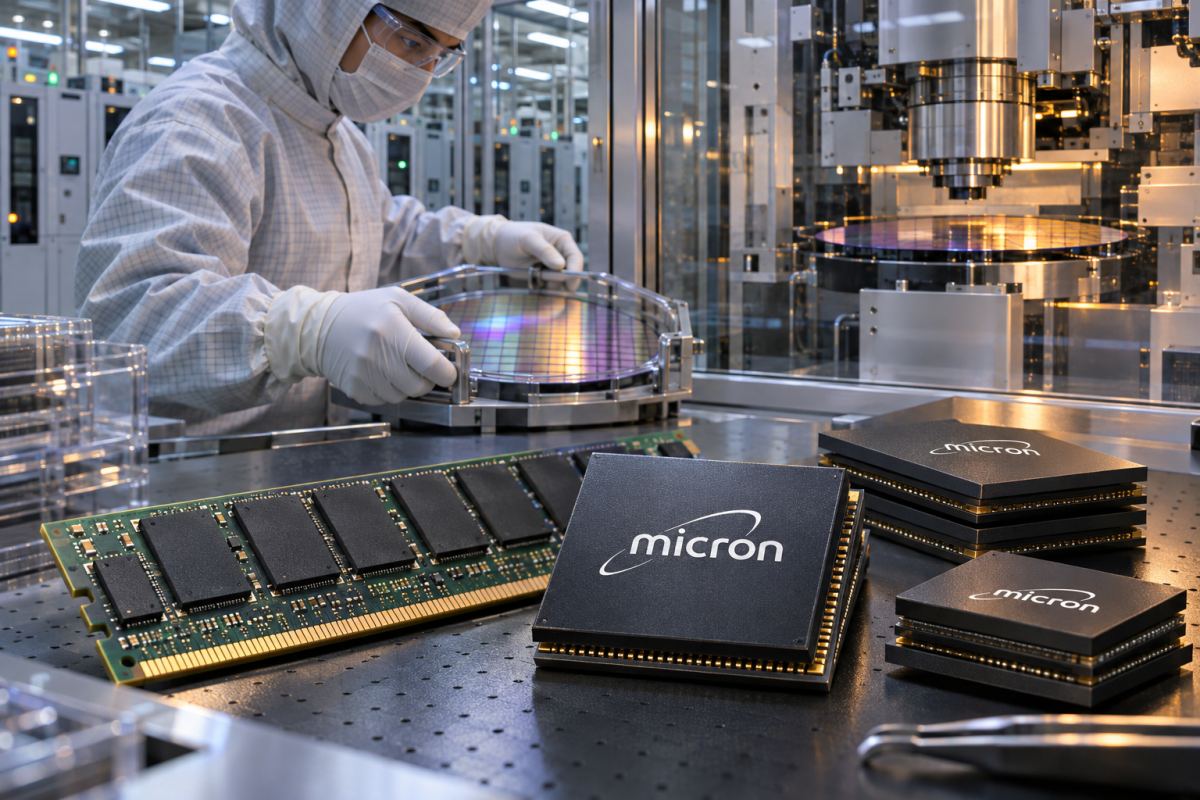
Micron began volume production of HBM4 during 2026 and described products designed for next-generation computing platforms. Stacking memory and improving the connections between components can increase data movement near the processor. The commercial opportunity lies in solving a system bottleneck: additional computing power is less useful if it spends too much time waiting for information.
That opportunity also raises the technical demands. Advanced packaging, power efficiency and product qualification matter alongside the number of memory bits produced. A supplier must satisfy customers’ performance and delivery requirements across a product generation. Announced specifications or samples are different milestones from qualified high-volume shipments, and the next product’s planned launch should not be treated as completed production.
Micron spent $5.650 billion on research and development in fiscal 2026. The purpose extends beyond creating a more capable premium product. Process improvements can lower the cost of producing each unit of memory and preserve competitiveness in broader markets. In this industry, product design, factory technology and cost control are closely connected rather than separate stages that can be optimized independently.
Longer contracts change the conversation
One of the most important developments appears in the annual report’s customer contract disclosures. Micron has strategic agreements containing enforceable purchase-volume commitments over several years. Some use fixed prices and many include minimum and maximum pricing bands. These arrangements can offer more visibility than relying exclusively on short-term purchases, but they do not turn every future transaction into a fixed profit.
At September 3, the company reported approximately $134 billion in remaining performance obligations. About a quarter was expected to become revenue over the following twelve months, with the remainder recognized within five years. The figure is not revenue already earned, and it is not a comprehensive forecast of all future sales. Certain variable-price and short-duration contracts are excluded from the calculation.
Contract liabilities included roughly $13 billion associated primarily with customer deposits. Nearly all those deposits were scheduled for repayment between 2029 and 2031. A deposit supplies financing but also carries an obligation; it should not be described as free shareholder cash. The value of longer agreements still depends on enforceability, counterparties and Micron’s ability to supply the promised products.
The industrial bill behind the earnings
Year-end assets totaled $195.888 billion, up from $82.798 billion. Net property, plant and equipment accounted for $63.310 billion. Cash and equivalents were $38.364 billion, alongside $5.070 billion in short-term investments and $30.019 billion in long-term marketable investments. Those categories should be distinguished before describing how much money is immediately available for a particular use.
Operating cash flow was $89.675 billion for fiscal 2026. Gross cash spending on property, plant and equipment was $30.712 billion. Government incentives and other adjustments can produce a lower net investment measure, but they should not be silently substituted for gross cash purchases. Large earnings have strengthened the company’s financial capacity while leaving a substantial need to reinvest in production.
Current debt was $491 million and long-term debt $4.688 billion at the fiscal year-end. The balance sheet provides resources for expansion, but announced facilities require time. Micron projected initial output from its first new Idaho fabrication plant in mid-2027 and from its first New York plant in 2030. As of November 5, those were future production expectations, not factories already adding commercial output.
Why a low historical multiple can still be demanding
Micron common stock trades on Nasdaq under MU. The November 5 market value of approximately $742.65 billion was about 8.7 times fiscal 2026 GAAP net income. Compared with many technology companies, that historical multiple may look modest. Yet a multiple calculated using exceptional earnings can be misleading if the denominator falls sharply during a weaker pricing environment.
The board declared a quarterly dividend of $0.15 per share in September, payable in October. Dividends and potential repurchases must be considered alongside factories, research and customer obligations. Distributing cash can reward shareholders, while retaining it can fund the capabilities required for the next product cycle. Neither decision is automatically superior without considering price, opportunity and financial resilience.
Micron’s history is a record of industrial persistence, now meeting an unusually strong period of demand. Advanced memory and customer contracts may improve the quality of the business, but they do not eliminate execution or cycle risk. The lasting investment question is whether today’s profits can finance a stronger position that remains valuable when supply expands, products change and customers reassess their next round of computing expenditure.