ExxonMobil’s Power Runs From the Oilfield to the Refinery
Resources, refining and specialized products form an industrial system built for decades. ExxonMobil’s history, cash flows and latest accounts reveal how integration shapes both returns and risk.
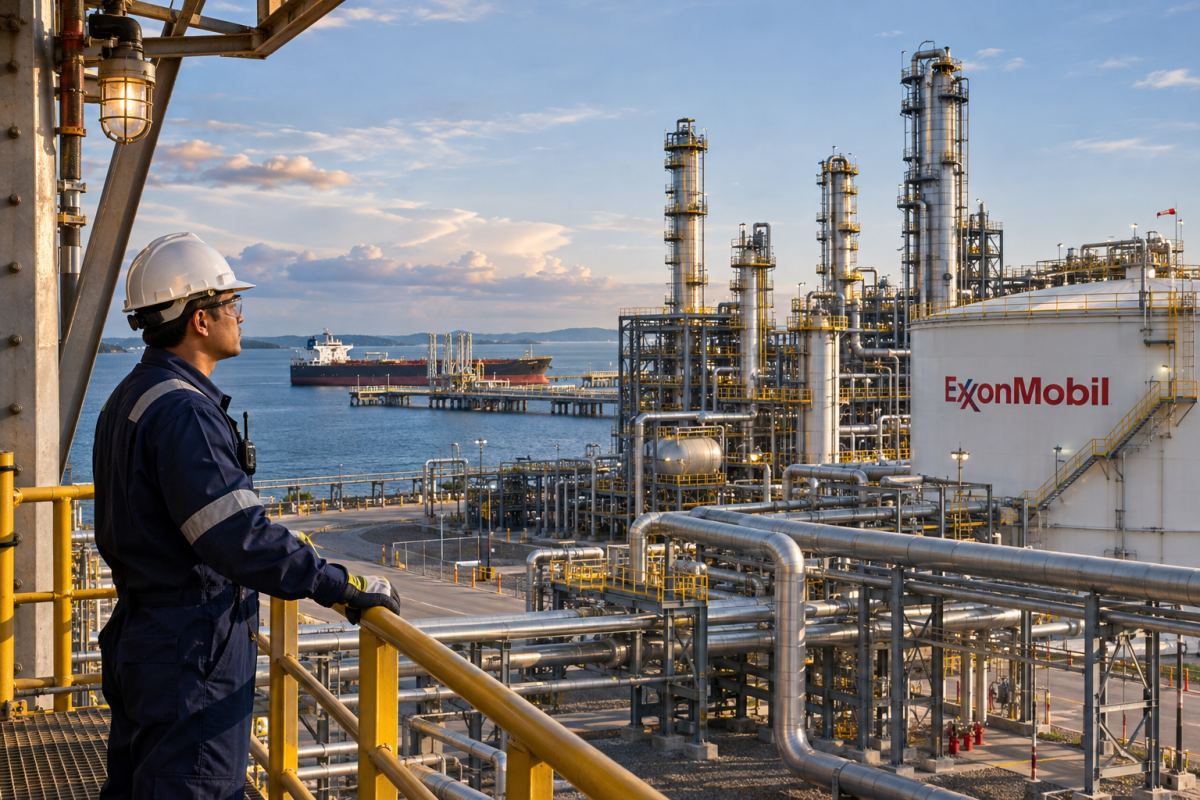
An oilfield and a refinery can react differently to the same movement in energy prices. ExxonMobil owns both, alongside chemical and specialty-products businesses, giving it several ways to participate in the journey from underground resources to finished materials. That integration is central to its history. It also explains why the company cannot be understood simply by checking the latest price of crude oil.
ExxonMobil’s equity value was approximately $674.29 billion in the November 5, 2026 snapshot. Its shareholders own a claim on an industrial system built over decades, with investments that often take years to produce cash. The investment question is how effectively the company can convert resources, technology and physical assets into returns through changing commodity markets and a changing energy system.
Old industrial roots, a newer corporate structure
The company’s ancestry includes businesses separated in the 1911 breakup of Standard Oil. Jersey Standard adopted the Exxon name in 1972, and Exxon and Mobil reunited in a merger completed on November 30, 1999. The current business therefore combines a long industrial inheritance with repeated changes in organization. Its scale was assembled, rather than created in one discovery or one transaction.
A more recent change affects the listed entity itself. On July 1, 2026, a redomiciliation reorganization placed ExxonMobil Holdings Corporation, incorporated in Texas, above the operating company. Shareholders received one holding-company share for each predecessor share, and the New York Stock Exchange symbol remained XOM. This was a corporate restructuring, not the creation of an entirely new operating business or a reset of its financial history.
The May 2024 acquisition of Pioneer Natural Resources expanded its position in the Permian Basin. Bringing neighboring resources and capabilities together can support more coordinated development, but the acquisition also required consideration and assumed obligations. Its success must ultimately be measured through production, costs and cash returns, rather than the acreage added or the headline size of the deal alone.
Chairman and chief executive Darren Woods leads a company with upstream production, refining and fuels, chemicals, and specialty products. These activities have different market exposures. Higher feedstock costs can hurt some downstream operations even as they benefit production. Integration creates options and operating connections, but does not mean every division gains from the same market conditions at the same time.
Sales, other income and the annual result
For the year ended December 31, 2025, sales and other operating revenue were $323.905 billion. Total revenues and other income were $332.238 billion after including income from equity affiliates and other income. The two figures should not be used interchangeably. Distinguishing ordinary operating sales from the broader income total is especially useful when comparing energy companies with different reporting presentations.
Net income attributable to ExxonMobil was $28.844 billion, down from $33.680 billion in 2024, with diluted earnings per share of $6.70. A commodity producer’s revenue can fall because the price of its output changes even if its physical operations remain productive. Profits also depend on refining margins, chemical conditions, taxes, maintenance and impairment charges. One annual comparison cannot isolate all those effects.
At December 2025, total assets were $448.980 billion, including $299.373 billion of net property, plant and equipment. These facilities and resource-related assets represent a large industrial commitment. Their book value is not the same as the market value of future production, and neither measure is equivalent to the company’s equity capitalization. Shareholders are also exposed to the obligations and costs required to operate them.
Operating cash flow was $51.970 billion during 2025, while cash additions to property, plant and equipment were $28.358 billion. This spending measure differs from broader capital-and-exploration presentations. Developing resources and maintaining facilities consume a significant portion of operating cash before dividends, buybacks and other financing decisions. The business must repeatedly invest to keep future output and operating capabilities competitive.
A quarter when refining matched production’s contribution
The latest reported quarter ended September 30, 2026. Operating sales were $110.503 billion, while total revenues and other income reached $113.164 billion. Net income attributable to the company was $15.413 billion and diluted earnings per share $3.72. Its adjusted earnings measure was higher, at $17.505 billion or $4.23 per share; those were separate presentations, not the reported result.
The segment contributions reveal an unusually instructive balance. Upstream earned $7.088 billion, while Energy Products earned $7.169 billion. Chemical Products added $735 million and Specialty Products $1.285 billion, before a corporate and financing loss of $864 million. The fuels business contributed slightly more than upstream production, demonstrating why an integrated company’s results require more than an oil-price narrative.
Upstream output was approximately 4.496 million oil-equivalent barrels a day. Oil equivalent combines different energy products, including natural gas, on a common basis; it does not mean every unit was a barrel of crude. Similarly, a gross production figure for a particular development would not necessarily equal ExxonMobil’s share. Production measures need their scope stated as carefully as financial results.
Quarterly operating cash flow reached $25.7 billion, and company-defined free cash flow was $19.1 billion. Shareholder distributions totaled $9.4 billion, including $4.3 billion in dividends and $5.1 billion in repurchases. The relationship between cash generated, investment and distributions is more revealing than examining any one figure alone, particularly in a quarter with favorable margins.
The balance sheet buys time, not immunity
At September 2026, total assets were $470.917 billion, with net property, plant and equipment of $296.955 billion. Cash and equivalents were $12.153 billion. Notes and loans payable totaled $4.523 billion, alongside $29.727 billion of long-term debt. A stronger financial position can help sustain projects through a weaker market, but it does not remove commodity exposure or guarantee attractive returns from each investment.
Large energy projects involve decisions made well before their eventual selling prices are known. Geological performance, construction costs, partner relationships and operating reliability can change the economics after approval. Capital discipline therefore includes choosing what not to build, when to defer a project and whether an existing asset would be more valuable to another owner.
The company’s operating improvements should also be separated from market effects. Better utilization or lower recurring costs can improve the business, while higher commodity prices can lift earnings without the same internal change. Management attributes part of its progress to structural savings. Investors still need to examine how those claims interact with inflation, acquisitions, maintenance and the price environment.
Energy transition adds a second investment horizon
ExxonMobil is also pursuing activities such as carbon capture and storage. Their economics differ from simply extracting another barrel: customers, transport infrastructure, storage rights and policy arrangements may all matter. An announced project or an emissions objective is not evidence that the expected return or environmental outcome has already been achieved. Commercial commitments and operating performance remain the meaningful tests.
The transition creates uncertainty in both directions. Existing fuels and materials continue to have users, while efficiency, electrification, regulation and competing technologies can change future demand. The company must decide which assets are likely to remain productive over long periods. A forecast of continuing demand should be treated as a scenario to manage, rather than a promise that every current asset retains its value indefinitely.
Environmental obligations, safety and operational disruption also have financial consequences. A facility requires maintenance and compliance even when selling prices weaken. The scale of the asset base makes small improvements valuable, but it also makes failures costly. Assessing the company’s resilience therefore requires looking at liabilities and operating risks as well as production growth.
What XOM shareholders are being offered
The November 5 equity value was roughly 23 times reported 2025 net income. This is a historical comparison using a cyclical year, not a forecast valuation multiple. A rise or fall in commodity earnings can change that ratio rapidly without a matching change in industrial capability. The share price expresses expectations about a stream of future cash, rather than ownership of assets at their accounting cost.
The company declared a fourth-quarter dividend of $1.07 per share, payable in December 2026. It also announced planned 2027 repurchases of $20 billion. The dividend had been declared, while the next year’s buybacks remained a plan; neither should be confused with the distributions already made during the third quarter. Future investment requirements and market conditions remain relevant to capital allocation.
ExxonMobil’s enduring advantage, if it can maintain it, lies in making a complex industrial system work across markets and decades. Its latest results demonstrate the earning power of both resources and refining. The lasting question is whether disciplined investment can preserve that cash-generating capacity while demand, technology and environmental obligations change around an asset base built for the long term.