WHEN ALL FLYERS LOOK ALIKE, NO BRAND IS REMEMBERED
Artificial intelligence can create an attractive image in seconds, but using it without judgment is making completely different businesses start to look exactly alike.
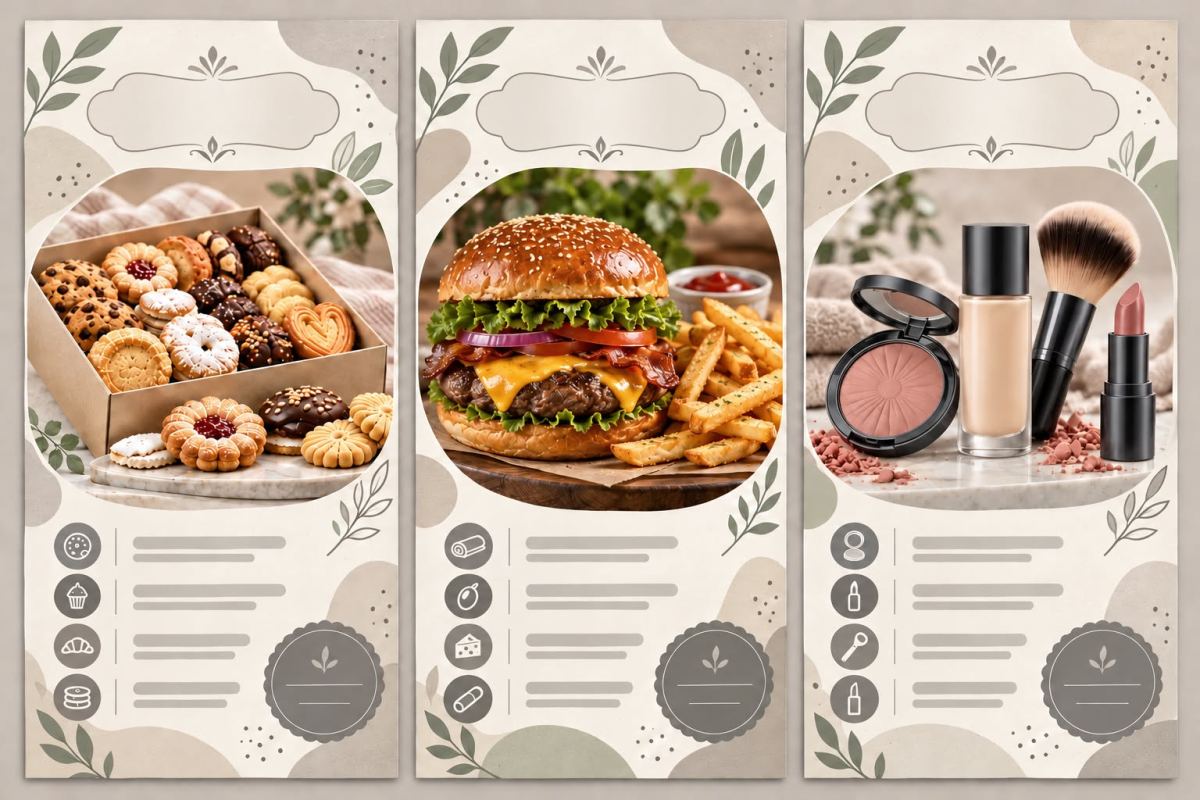
This is the first in a series of three articles about brand identity in the age of artificial intelligence. In this first installment, we will discuss an increasingly visible phenomenon: completely different businesses that are starting to use the same faces, backgrounds, colors and styles in their flyers.
Lately, I have been noticing flyers from completely different businesses that look as though they were created for the same brand. The name changes, the product changes and the price changes, but the image feels the same.
We see the same perfect models, the same poses, the same glossy backgrounds, the same flowers, the same floating objects and even the same typefaces. If we removed the logo, it would be difficult to tell whether the flyer belonged to a baker, a clothing store, a beauty salon or a real estate agent.
Everything looks beautiful. But almost none of it feels distinctive.
Artificial intelligence has made it possible for someone with no design knowledge to generate impressive images in a few seconds. This is an enormous opportunity for small businesses, especially for those who cannot regularly hire a photographer, designer or creative team.
The problem is not using artificial intelligence. The problem is believing that a beautiful image automatically represents our brand.
When we enter a general instruction such as ‘create an elegant flyer to promote my business,’ the tool uses common references to interpret what elegance means. Then come the gold, the sparkle, the sophisticated lettering, a perfectly styled woman and a setting we have probably already seen on many other accounts.
The image may be attractive, but it may also resemble hundreds of images generated with similar instructions. Artificial intelligence responds to what we ask of it. If we do not give it a clear direction, it fills the gaps with what is most common and recognizable. That is why so many brands are starting to look alike.
In baking, this problem is even more evident. I have seen images of cookies, cakes and macarons so perfect that they look like plastic objects. The chocolate flows in an impossible way, the fillings have a texture that does not exist, and the products appear surrounded by floating ingredients in spectacular settings.
The image attracts attention, but it can also create a promise that the real product will not be able to fulfill.
When a customer buys a dessert, they expect to receive what they saw. If the flyer shows a cookie created entirely with artificial intelligence and the actual product has a different shape, a different color and a different texture, we are no longer using the image simply as decoration. We are changing the customer’s expectations.
Good presentation should increase the value of what we sell, not replace it.
That is why I continue to believe deeply in real photographs. They do not have to be perfect or require an expensive production. Good lighting, a consistent background and a carefully considered composition can show the product attractively without taking away its truth.
The small crack in a cookie, the texture of a dough, the particular shape of a macaron or the way a filling actually flows are also part of its identity.
Artificial intelligence can help us build a background, explore a concept, remove a distraction or visualize an idea before producing it. But we should use it to support creativity, not to replace everything that makes our work recognizable.
The risk of depending entirely on these tools is not just that the public discovers the image is not real. The greater risk is that our brand ends up getting lost within an aesthetic that everyone is using.
If someone sees our flyer and thinks ‘how beautiful,’ but five minutes later cannot remember who posted it, the piece attracted attention but did not build identity.
Before creating or publishing a flyer with artificial intelligence, we can ask ourselves a few questions.
Questions to ask before publishing a flyer created with artificial intelligence
- Does the product shown really look like the one the customer will receive?
- Could I change the business name and use exactly the same flyer for another brand?
- Am I using artificial intelligence to develop an idea or to avoid making creative decisions?
- Does this image relate to the rest of my communication, or did I choose it only because it looked impressive?
- Does the customer quickly understand what I sell, what the promotion is and what they need to do?
We should also remember that a flyer does not have to contain everything. We often fill a piece with photographs, text, decorations, prices and different typefaces because we feel that every space must be used. Communicating better does not always mean adding more elements. It means establishing a priority.
What do I need the person to understand first? What do I want them to remember? What action should they take after seeing the post? Artificial intelligence can generate an image in seconds, but it does not know the answers on its own. That part still requires our strategy and judgment.
We do not need to reject new tools to protect authenticity. We need to learn how to direct them. We can use them to expand our possibilities without handing over our identity entirely.
A tool can create a perfect woman holding a perfect box in a perfect setting. But perhaps what our community needs to see is the real person who prepares the product, her hands at work, her workspace and what only she knows how to do.
In a world filled with flawless images, reality can also become a way to stand out.
The goal should not be for someone to look at our flyer and simply say, ‘How beautiful.’ The real goal is for them to be able to say, ‘I know whose it is,’ even before finding the logo.
In the next installment, we will explore why some brands can be recognized even when they do not show their name or logo, and what a small business can learn from that ability to remain in people’s memory.