Frieze opens in London: contemporary art, outdoor sculpture and Renoir
Frieze Week connects Regent's Park with exhibitions at the Barbican and the National Gallery, revealing London's cultural appeal beyond the art market.
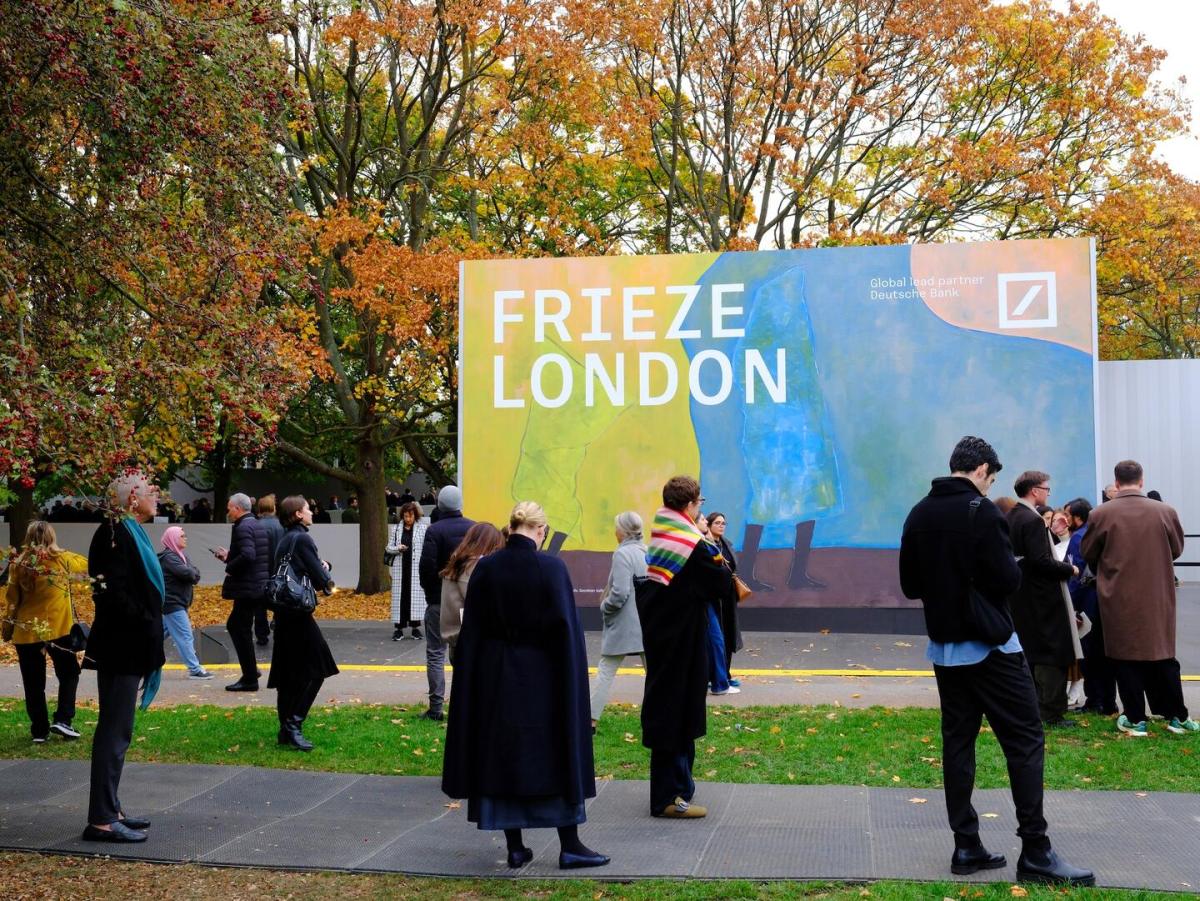
London begins Frieze Week on Wednesday, October 14, bringing contemporary art and major strands of art history together in Regent's Park. The opening day is invitation-only; general admission to Frieze London and Frieze Masters starts on Thursday, October 15. For visitors to the city, the appeal reaches well beyond the fair tents.
The program brings together international galleries, emerging artists, outdoor sculpture and exhibitions at London institutions. That concentration makes it possible to explore different approaches to art in one trip: work entering the market, projects recovering overlooked histories and pieces that transform public space.
Frieze's commercial role is unmistakable, but it does not define the whole experience. Visitors who have no intention of buying can explore presentations selected by gallerists and curators, compare artistic approaches and consider the questions shaping artists' work today. This edition offers several clear starting points.
Two fairs, different perspectives
Frieze London and Frieze Masters run through October 18. The former brings together more than 170 galleries, focusing on contemporary work. The latter takes a longer view, with pieces ranging from ancient civilizations to the 20th century.
Announced highlights at Masters include Anthony van Dyck's portrait of a nobleman and an Egyptian bronze of Ptah from the 26th Dynasty. They illustrate the shift in time and perspective between the two fairs: one introduces new artistic explorations, while the other invites visitors to reconsider objects and artists from earlier centuries.
The program also includes Queering Modernism, a curatorial strand by Anke Kempkes exploring queer histories and experiences in modern art. It raises a question that runs through museums and collections: which artists became central to the established narrative, and whose careers remained at its edges?
There is no single route through this range of work. Following one artist allows for close attention to a particular practice; comparing sections reveals differences across media, generations and settings. With so much on offer, choosing a few themes is more useful than trying to see everything.
Popular culture becomes part of the conversation
A new section at Frieze London, The Code Universe, is curated by Carol Yinghua Lu. It examines how artists respond to social change through everyday objects, consumer culture and images circulating in the media.
Participants include Shinro Ohtake, Selma Selman, Carolyn Lazard and Nikita Kadan. Ohtake's presentation by greengrassi and the Japanese gallery Take Ninagawa brings a Japanese perspective to this international exploration of popular culture.
Artist-to-Artist offers a different way to discover work. Seven artists have solo presentations after being nominated by more established peers. Louise Giovanelli selected Paul Robas; Otobong Nkanga nominated Jota Mombaça.
Focus concentrates on younger galleries. The fair's guide describes Benjamin Lallier's installation combining a fountain, video and drawings. Tamo Jugeli turns an exhibition space into a domestic interior using paintings and wallpaper. The setting in which a work is presented becomes part of its meaning.
The park is an exhibition, too
For an introduction to Frieze without entering the fairs, the most direct option is in the English Gardens of Regent's Park. Frieze Sculpture is a free outdoor exhibition that opened in September and remains on view until November 1.
Curated by Fatoş Üstek, it brings together 11 international artists. The works include Angel Otero's intervention suggesting a threshold beneath the lawn and Tarini Sethi's stainless-steel screens depicting utopian scenes. Ivana Bašić and Conrad Shawcross also participate.
The setting changes the encounter with the work. Rather than moving through a fair tent, visitors can combine art with a walk and approach sculptures from different angles. There is no need to turn the visit into a purchasing decision or reduce it to a checklist of famous names.
Yuko Mohri at the Barbican
The week's art itinerary also leads to In Concert, Yuko Mohri's exhibition in the Barbican's Curve gallery. The Japanese artist uses light, sound, kinetic sculpture and objects from the center itself to explore transformation and repair.
The Barbican explains that Mohri combines everyday objects with shifting forces such as water, air, gravity and magnetism. Her installation responds to conditions in the gallery and engages with the Barbican's period of renovation. What matters is not only the object on display, but also how it changes and interacts with its surroundings.
British magazine Wallpaper included the exhibition among its Frieze Week selections, alongside projects at galleries and other museums. That spread across the city is part of the week's attraction: visitors have reasons to leave the main fair site and explore other parts of London.
Renoir offers a different point of reference
At the National Gallery, Renoir and Love brings together 40 paintings centered on human connections: friendship, couples, families and shared lives. It focuses on the 1860s through the 1880s and is organized with the Musée d'Orsay and the Museum of Fine Arts, Boston.
A centerpiece is Bal au Moulin de la Galette, painted in 1876 and loaned by the Musée d'Orsay. According to the National Gallery, it is being exhibited in the United Kingdom for the first time.
Renoir, Mohri's installations and the presentations at Frieze can be brought together in an itinerary without blurring their different periods and purposes. London this week offers a chance to consider how art changes and how often it returns to people, their relationships and the spaces they inhabit.