Toledo high-speed train crash kills at least 60; Madrid–Andalusia services halted
A Renfe AVE train struck a stationary Iryo train near Urda. The death toll is provisional, rescue work continues and no official cause has been established.
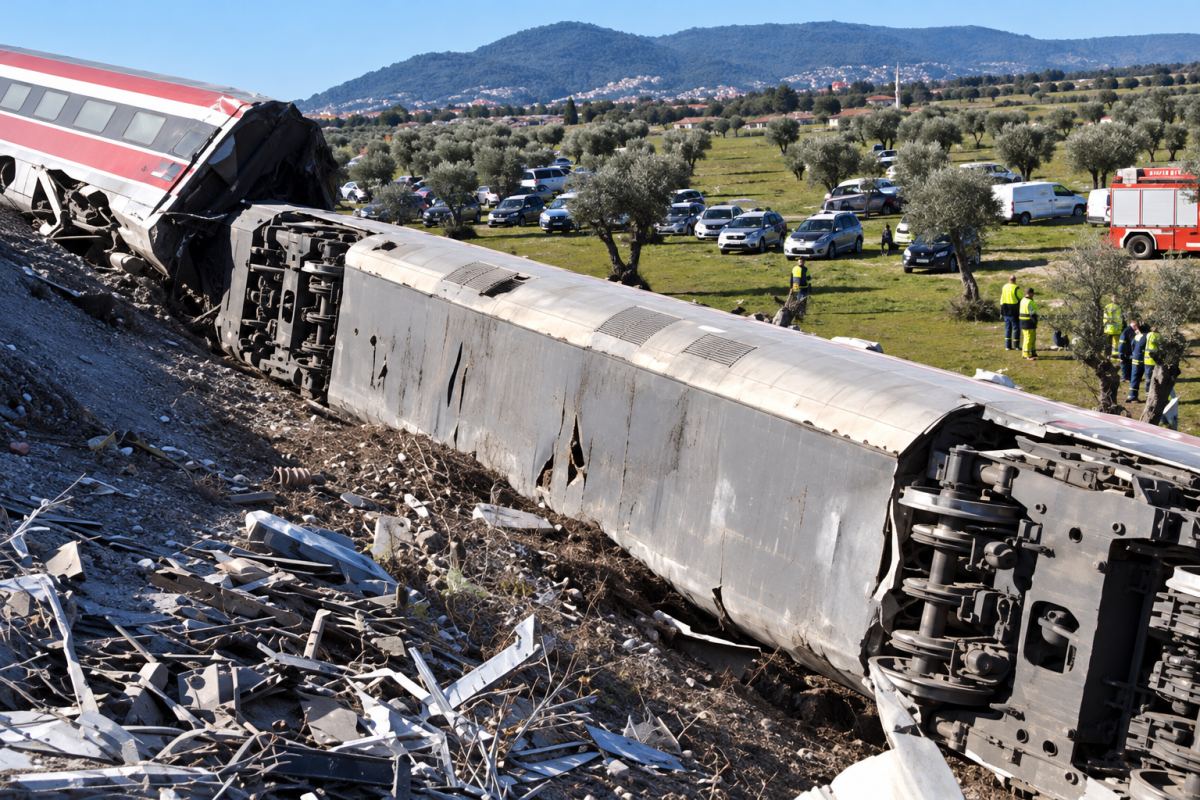
Two high-speed trains travelling from Madrid to Seville collided on Wednesday morning in Spain’s Toledo province. Sources in the Castilla-La Mancha regional government told El País that at least 60 people had died by around midday, while rescue operations continued. The toll was provisional. The crash halted high-speed rail traffic between Madrid and Andalusia and brought firefighters, medical teams, Civil Guard officers and civil protection crews to the scene.
The collision happened at 8:54 a.m. local time near kilometre 118 of the Madrid–Seville line, between Mora y Orgaz and Urda. A Renfe AVE train struck the rear of an Iryo train that had stopped on the tracks. About 544 people were aboard the two trains, according to regional government spokesperson Esther Padilla. The number of casualties could change as rescuers gain access to damaged carriages and identification work continues.
Rescue work and disruption to rail services
Images released by Spain’s Civil Guard show carriages off the tracks after the impact. Two went down an embankment, according to initial information from emergency services. The extent of the damage meant the morning’s casualty figures could not be treated as final. Rescue teams were working to account for everyone on board, remove injured passengers and take them to hospitals. A definitive count of those affected was not yet available.
At 9:15 a.m., the Castilla-La Mancha government activated its territorial emergency plan, known as PLATECAM, at operational level 1 for Toledo province. The plan coordinates the teams responding at the site and provides for a forward command post. Local authorities opened a sports hall in Urda to assist people affected by the crash. Regional president Emiliano García-Page cancelled his engagements and travelled towards the scene.
Spain’s rail infrastructure manager, Adif, confirmed that high-speed services between Madrid and Andalusia had been suspended. The closure affects a major route linking the capital with Ciudad Real and several Andalusian cities. Passengers due to travel on Wednesday should check directly with their operator: the closure of a line does not establish that every service has been cancelled or that the same alternative applies to every journey. Renfe and Iryo are responsible for notifying passengers about changes, transfers and refund terms for their particular trains and tickets.
The crash involved two operators competing on Spain’s high-speed network: state-owned Renfe and Iryo. Investigators will need to examine the infrastructure, signalling, control centre and each train separately. The fact that both trains were using the same line does not, by itself, establish what caused the collision or who may be responsible.
What is known about the sequence
The information available indicates that the Iryo train was stationary when the AVE hit it from behind. Citing preliminary analyses, El País reported a fault in a safety system that had stopped several trains in the area, followed by instructions to resume movement. Investigators were still examining why the Iryo train did not move on and how the train behind it was cleared to proceed. The regional government spokesperson said there was no official finding on the cause of the crash.
There is an important distinction between an early reconstruction of events and a technical conclusion. Investigators will need traffic records, communications between drivers and the control centre, data from the trains and evidence about the state of the signalling system. The speed of the impact had not been officially established at the time of this report. Calling it a proven case of human error now would turn an untested hypothesis into a finding.
An Iryo passenger interviewed by Catalunya Ràdio described a violent impact after his train had been stopped for several minutes. His account is direct testimony about his experience, not a technical measurement or a full account of what happened in every carriage. Images and eyewitness reports convey the scale of the crash, but the final casualty figures must come from the authorities carrying out the rescue and identification work.
A vital rail route and an investigation still to come
The collision occurred on the same broad rail corridor as the January 2026 accident at Adamuz, in Córdoba province, but on a different section and in circumstances that cannot be equated without evidence. That disaster killed 46 people. The shared route and the involvement of the same operators raise fresh questions about rail safety, but they do not demonstrate a common failure. Each accident requires its own reconstruction and findings.
For families, the immediate priority is reliable information about the people on board. For rail passengers, it is knowing which services can run and how to rearrange their journeys. The wider question for Spain’s rail network comes after the emergency response: what failed in the chain of safeguards, and what measures could prevent another crash. Until investigators and rescue teams complete their work, the death toll, the condition of the injured and the cause remain subject to official updates. This report reflects information available on the morning of 28 October, before the work at Urda was finished.