Spain's most serious train collisions of the 21st century: from Chinchilla to Urda
Seven train-to-train crashes, their casualties, documented causes and the questions still open after Adamuz and Urda.
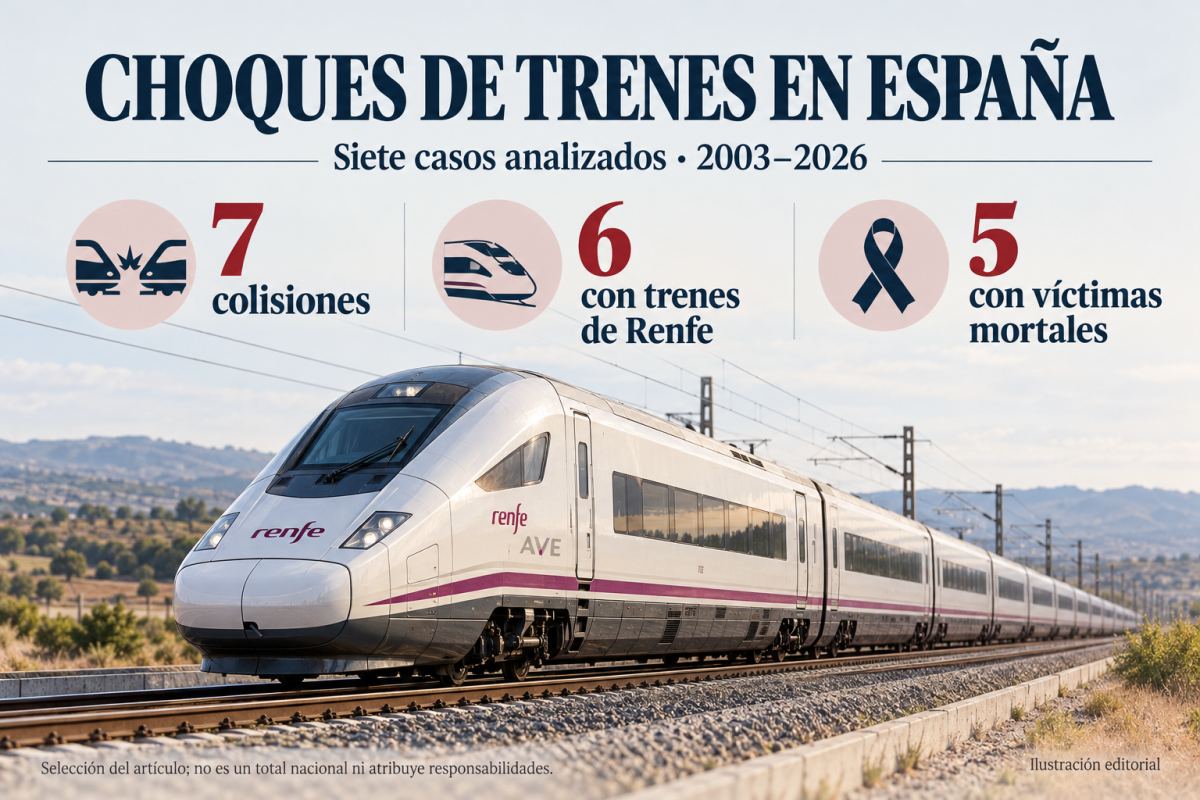
A Renfe AVE train struck the rear of a stationary Iryo train near Urda, in the province of Toledo, on Wednesday. With at least 64 people dead in a provisional toll released before 3 p.m. in Spain, it ranks among the country’s deadliest rail collisions this century. Earlier crashes followed very different paths: a mistaken departure clearance at Chinchilla, a failure in traffic control at Castellgalí and inadequate braking on a freight locomotive near Vila-seca. The cause of the Urda collision remains under investigation.
Investigations into Adamuz and Urda, the two deadly high-speed collisions of 2026, remain open. Findings released so far explain parts of the sequence, but have not settled every cause or question of responsibility.
Chinchilla, 2003: 19 deaths on a single-track line
On the night of June 3, 2003, a Talgo passenger train bound for Murcia and a freight train travelling in the opposite direction collided head-on near Chinchilla de Montearagón station, in the province of Albacete. Nineteen people died and 48 were injured, according to the figures recorded in a 2006 court ruling. For years, it was the deadliest collision between trains in 21st-century Spain.
The court sentenced the stationmaster to two years in prison. It found that he had authorised the Talgo to depart and set its signal to green while the freight train was occupying the same line. The ruling established criminal and civil liability, including compensation for victims. The disaster also exposed the danger of a conflicting movement authority on a single-track section: once two trains are sent towards one another, there may be nowhere to avoid a collision.
Castellgalí, 2019: a train routed against the normal direction of traffic
On February 8, 2019, a commuter train and a regional service collided head-on at Castellgalí, near Barcelona. One of the drivers died, and 108 people were injured, 19 of them seriously. Spain’s rail accident investigation commission, known as the CIAF, examined both the route set at Manresa station and the subsequent traffic-control decisions.
Its final report found that one train had entered a section of track in the wrong direction while it was occupied by the other. The investigators described an incorrectly set departure route and checks that failed to detect the abnormal movement in time. Their findings point to a chain of failures, rather than a single action that explains the whole collision. The commission’s safety recommendations addressed the procedures and safeguards intended to prevent trains from being assigned incompatible paths.
Sant Boi, Vila-seca and Montcada: three different collisions in 2022
At Sant Boi de Llobregat on May 16, 2022, a wagon on a freight train derailed into the path of a passenger train operated by Ferrocarrils de la Generalitat de Catalunya, the Catalan regional railway. The impact on the passenger train’s cab killed its driver and injured 86 people. An internal FGC investigation found that the freight train had been travelling at 43.5 km/h through a section temporarily limited to 30 km/h. That finding helps explain the sequence of events, but it is not a court judgment assigning all legal responsibility for the crash.
Less than a month later, on June 12, a freight locomotive collided head-on with a regional passenger train near Vila-seca, in the province of Tarragona. No one died. The CIAF’s final report counted 29 injured people, including six seriously injured; 22 people needed to be taken to medical facilities, according to the contemporary government emergency bulletin. The commission traced the collision to insufficient braking power on the locomotive, caused by an incorrectly adjusted brake mechanism after its wheels had been reprofiled. The line closed temporarily, delaying or cancelling dozens of services.
On December 7, two R4 commuter trains collided at Montcada i Reixac-Manresa station, near Barcelona. An arriving train ran into the rear of another that was stopped at the station. The emergency medical service recorded 155 injured people: 150 with minor injuries and five whose injuries were assessed as moderate. There were no deaths. The crash disrupted the R4, R7 and R12 lines. The sequence is documented, but the available reports do not establish a definitive technical cause.
Adamuz, 2026: a derailment followed by a collision
On January 18, 2026, the rear cars of an Iryo train travelling towards Madrid derailed near Adamuz, in the province of Córdoba. They entered the track of an oncoming Renfe Alvia train, which then struck them. The collision between the two trains killed 46 people.
The technical investigation has focused on a rail fracture that preceded the accident. Spain’s Civil Guard placed the fracture on the previous day, while CIAF analyses strengthened the suspected link with the derailment. The commission has also warned that its interim findings are not a final report. A full account of the sequence and the measures needed to prevent a recurrence still depends on its definitive conclusions. Aid for victims was approved after the disaster, and rail links remained disrupted for weeks.
Urda, 2026: a provisional death toll
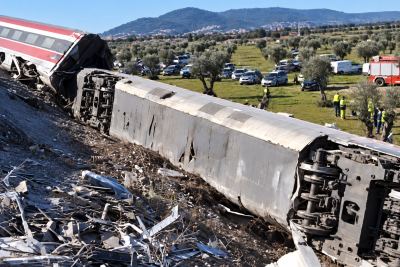
At 8:54 a.m. local time on October 28, 2026, a Renfe AVE train struck the rear of a stationary Iryo train near Urda, in Toledo province. The Castilla-La Mancha regional government activated its emergency plan, and high-speed services between Madrid and Andalusia were suspended. Regional president Emiliano García-Page reported at least 64 deaths in a toll issued before 3 p.m. Spanish mainland time. Dozens of people were also injured. The figures remained provisional as rescue work and victim identification continued.
The cause of the rear-end collision had not been established at that cutoff. Knowing that one train was stopped and the other struck it describes the event; it does not explain why the safeguards meant to keep them apart failed. Investigators will need to reconstruct the signals, movement records and communications before responsibility can be determined.
These cases show why casualty figures and explanations emerge on different timetables. Emergency crews can confirm deaths and injuries within hours. Reconstructing a technical sequence requires records, forensic work and often months of investigation. The lasting safety question is what failed in each case and how that failure can be prevented from happening again.