Sheinbaum and Xi seek closer Mexico–China cooperation amid trade tensions
The presidents met in Shenzhen ahead of the APEC summit. Mexico proposed expanding exports and exploring projects in technology, health care, agriculture and water management.
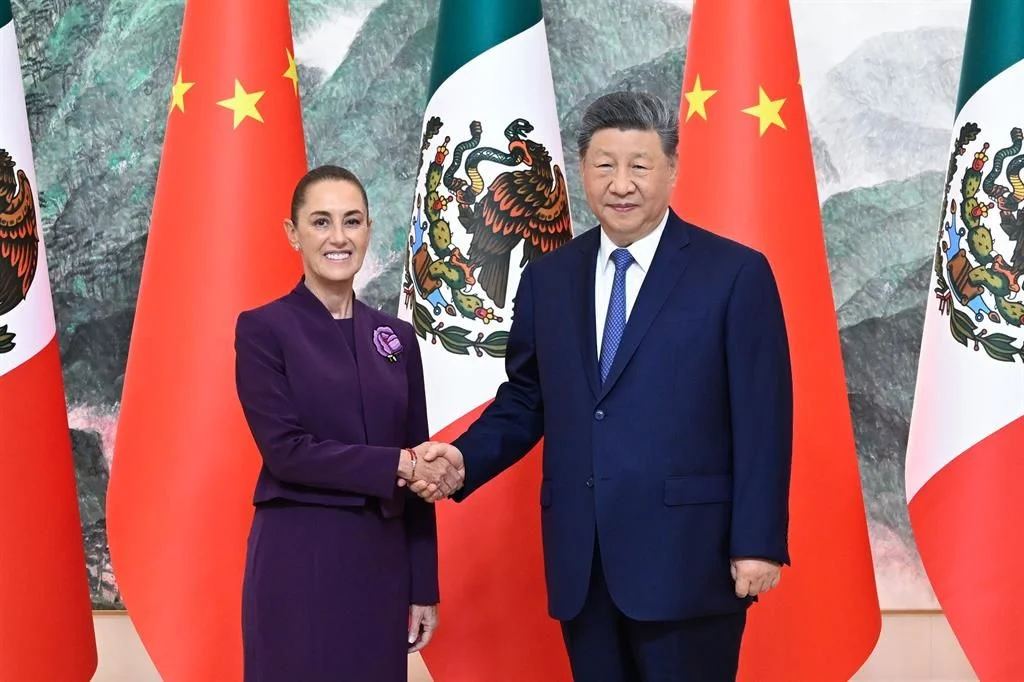
Mexican President Claudia Sheinbaum and Chinese President Xi Jinping met in Shenzhen on Tuesday to discuss an agenda ranging from trade and investment to technology, agriculture and water management. The meeting came amid trade tensions and negotiations between Mexico and the United States over the future of the North American trade agreement.
Speaking afterward, Sheinbaum said she had raised Mexico’s interest in selling more products to China, from avocados to tequila. She also discussed scientific, academic and environmental cooperation, as well as trains, small vehicles and smart hospitals.
The Mexican presidency said officials from both governments would follow up on the agreements reached, although it did not specify concrete measures or financial commitments, the EFE news agency reported. China’s Foreign Ministry said Xi had proposed deeper cooperation in infrastructure, technology, clean energy, culture and tourism.
The November 17 meeting took place ahead of the Asia-Pacific Economic Cooperation forum’s leaders’ meeting, scheduled for November 18–19 in the southern Chinese city. Sheinbaum and Xi previously met as presidents at the G20 summit in Rio de Janeiro in 2024.
A growing but uneven trade relationship
China is a major supplier to Mexico, but there is a substantial gap between the goods Mexico buys from China and those it sells there.
From January through September 2026, Mexico imported approximately $106 billion in Chinese goods and exported about $11.1 billion in goods to China. The resulting trade deficit was $94.878 billion, according to Bank of Mexico figures cited by El País.
That balance measures the difference in the value of goods bought and sold during the period. It does not, by itself, represent an equivalent loss to Mexico: imports include consumer products, machinery and components that can be used in other economic activities. Nor does it provide a separate account of trade in services.
Mexican exports to China grew in the first nine months of the year, although they remained far smaller than imports. An analysis of trade figures by Expansión identified copper and lead ores among Mexico’s main exports to the Chinese market. The value of copper exports rose from $2.666 billion in the same period of 2025 to $4.637 billion in 2026.
For Mexican producers, exporting a wider range of goods could create opportunities in a large market. Achieving that goal requires businesses to find buyers, meet applicable standards and transport their products at competitive costs, among other challenges. Government expressions of interest do not, on their own, guarantee new sales.
Sheinbaum specifically mentioned avocados and tequila when describing her talks with Xi. She said Economy Secretary Marcelo Ebrard would continue trade discussions with Chinese officials. Her remarks did not include figures for committed purchases of those products.
Tariffs and domestic production
The diplomatic outreach follows Mexico’s approval of tariff increases of up to 50% on selected products from countries with which it has no free trade agreement, including China. The increases were approved in late 2025 and took effect in 2026.
A tariff is a tax charged on imported goods. Its impact depends on the product and how businesses respond: it can increase the cost of buying abroad, affect prices or give domestic manufacturers more room to compete. Tariffs on inputs and machinery can also raise production costs for the companies that use them.
The Mexican government has linked these measures to its efforts to strengthen domestic industry and attract investment. Before traveling to China, Sheinbaum said the increases targeted certain sectors and countries without a trade agreement with Mexico.
Those measures coexist with an extensive economic relationship. Mexican businesses use goods and components from China, and consumers buy Chinese products in stores and online. At the same time, some domestic industries seek protection from imports they regard as difficult to compete against.
Against that backdrop, the bilateral discussion included Plan México, which the government describes as a strategy to attract investment and strengthen domestic production. China’s Foreign Ministry said Sheinbaum had expressed interest in cooperation on trade, investment, manufacturing, artificial intelligence, agriculture and water management as the plan is implemented.
Technology, health care and water on the agenda
The talks extended beyond trade in goods. After the meeting, Sheinbaum highlighted her government’s interest in smart hospitals being developed in China and mentioned cooperation on trains and small vehicles.
She said China was involved in manufacturing trains for Mexican projects, including the route between Mexico City and Pachuca. She raised the possibility of further collaboration in that field, without announcing a specific new rail contract in her subsequent remarks.
In health care, digital technology can help organize clinical information and manage hospital services. Adoption, however, depends on decisions about infrastructure, costs, data protection and staffing. The interest expressed in Shenzhen opens an area for discussion; its scope will depend on the projects the authorities subsequently develop.
Water management and clean energy also featured on the agenda. According to information from the Mexican presidency reported by EFE, the leaders discussed addressing sargassum, a seaweed whose accumulation can affect beaches and coastal activities.
China’s Foreign Ministry included education, health care and tourism among the areas of exchange mentioned by Sheinbaum. According to the same statement, Xi called for broader cooperation and continued coordination in multilateral organizations such as the United Nations.
Relations with the United States
The visit coincides with discussions on the review of the United States–Mexico–Canada Agreement, or USMCA. The U.S. market is crucial to Mexico: it receives most of the country’s exports, particularly goods made through production networks that span the border.
In July, the Office of the U.S. Trade Representative said U.S. and Mexican officials had discussed economic security, agriculture, steel, aluminum and automobiles, among other issues, during a negotiating round related to the agreement’s review. Both governments stressed the importance of strengthening North American manufacturing and supply chains.
USMCA rules of origin set the conditions products must meet to qualify for preferential tariffs. Depending on the goods, those conditions take account of factors such as where production occurs or the share of regional content. Investment or inputs from other countries do not, on their own, determine whether a product qualifies; the answer depends on the applicable rules.
Before the trip, Sheinbaum maintained that her meeting with Xi should not harm relations with the United States. Leaving the meeting in Shenzhen, she said the relationship with Washington and the trade agreement had come up. She added that the Chinese president had not made a particular request or proposal to her on that issue.
Sheinbaum also said she expected to briefly greet U.S. President Donald Trump during the APEC events. The leaders’ gathering of the forum’s 21 member economies gives Mexico further opportunities for dialogue in a region that includes both trading partners and competitors.
Mexico will host APEC in 2028. The year 2027 will also mark the 55th anniversary of diplomatic relations with China, an occasion Xi mentioned as an opportunity to strengthen exchanges. The next step in the bilateral agenda will be work by government teams to develop specific initiatives in trade, investment and technical cooperation.