Shenzhen is no new Yalta: Russia and the power conferred by threats
Analysis: the meeting of Trump, Xi and Putin raises a question about why the ability to threaten global security confers an authority that prosperity and innovation do not guarantee.
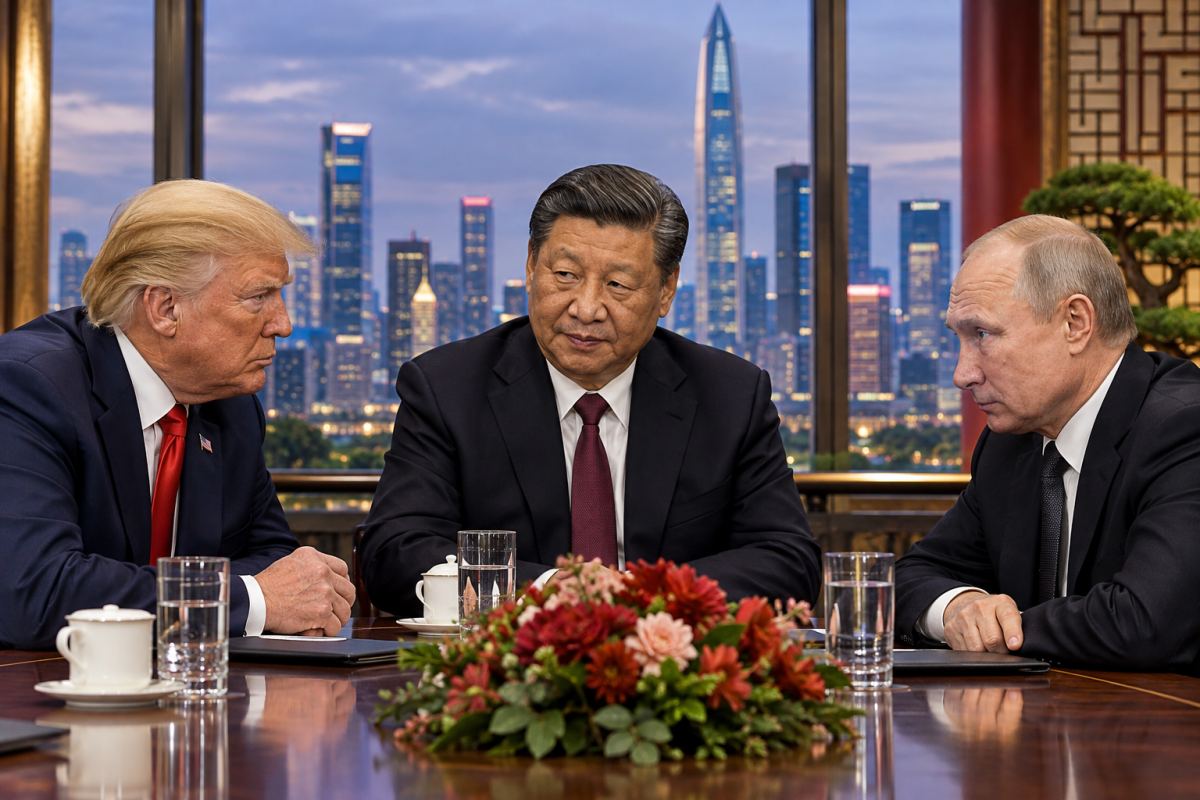
The meeting announced for November 19 between Donald Trump, Xi Jinping and Vladimir Putin in Shenzhen brings together three leaders whose countries have very different capacities to shape the future. The United States and China are competing for global economic and technological leadership. Russia retains an enormous nuclear arsenal and the willingness to use force to impose its interests. The photograph may place them on equal footing. That should not obscure the fact that Russia is a minor global player beside two giants interested only in its energy resources—and that, to secure them, Trump and Xi each flatter and indulge the Russian dictator.
The idea of a new Yalta appeals to those who imagine the world as a table reserved for a handful of men. It also concedes something to Putin: the standing of an arbiter of the international order, even as his government continues a war of conquest that has been stalled for four years and has killed hundreds of thousands of Russian soldiers, in a country whose population shrinks year after year.
A distinction is essential, however, between negotiating with Russia because doing so is indispensable to reducing a danger, and recognizing its right to decide the fate of other countries. The first is the work of diplomacy. The second perpetuates an imperial conception of international relations.
In February 1945, Roosevelt, Churchill and Stalin represented the major Allied powers that were defeating Nazi Germany and Imperial Japan. Their authority rested on a combination of economic resources, industrial mobilization, imperial reach and armies determining the war’s outcome. Above all, Yalta reflected the military balance of power. The occupation of Germany, questions concerning Poland, the future international organization and Soviet entry into the war against Japan were negotiated there.
For many European peoples, victory over Nazism led to decades of subordination to Moscow. Invoking that conference requires remembering both Hitler’s defeat and the limits of the promises of freedom made to those who had no seat at the table.
Today’s Russia occupies a very different position from that of the Soviet Union at the end of the war. According to the World Bank, its nominal GDP was approximately $2.56 trillion in 2025, compared with France’s $3.37 trillion. Its output per person was around $17,547, against nearly $43,000 in Italy. There is a considerable gap between the ambition to lead the world and the economic results delivered to the population.
A comparison with Latin America is also revealing: Russian GDP per capita was slightly below Chile’s roughly $17,995 and well below Uruguay’s approximately $25,216, according to the same institution. These figures measure average output, rather than each citizen’s actual income, but they help put the Kremlin’s rhetoric of greatness in perspective.
The gap is also evident in innovation. The World Intellectual Property Organization’s 2026 index ranks Russia 58th, compared with India in 38th place and Japan in 12th. No index captures a society’s capabilities in full, but these results hardly support the image of Russia standing alongside the United States and China at the global technological frontier.
Russia’s authoritarian inheritance
The most disturbing resemblance to tsarism lies in the organization of power: concentrated authority, the persecution of dissent and the equation of national security with obedience to the ruler. Human Rights Watch documented expanding repression in 2026 and cited Memorial’s count of 1,715 political prisoners as of July that year. Once again, the greatness of the state is demanded at the expense of its citizens’ freedoms.
Almost 110 years after the revolutions of 1917, the analogy carries a tragic weight. War, supply shortages and the discrediting of authority helped bring down the monarchy. Bolshevik power emerged from that crisis and eventually imposed another dictatorship. The historical warning lies in how readily a state sacrifices its development and its people to sustain military objectives it presents as nonnegotiable.
Poland offers a particularly disturbing precedent for that conception of power. Under Catherine II, Russia participated in the partitions that, together with Prussia and Austria, ultimately erased the Polish–Lithuanian Commonwealth from the map. In 1939, Stalin agreed with Hitler on a new division of territories and spheres of influence. Germany invaded Poland on September 1; the Soviet Union invaded from the east on September 17. Ideologies and regimes changed, but the willingness to treat a neighbor’s sovereignty as negotiable reappeared.
The Nazi–Soviet pact was instrumental in facilitating the aggression against Poland. Nazi expansionism had objectives of its own, and Stalin’s cooperation allowed Hitler to attack without fearing immediate Soviet intervention. Both regimes took part in the country’s dismemberment.
Afghanistan illustrates another way in which an invasion can spread violence far beyond its immediate reach. The Soviet intervention in 1979 helped turn the conflict into an international center of jihadist mobilization. The United States, Pakistan and Saudi Arabia supported the anti-Soviet resistance; Washington prioritized wearing down its adversary, while fighter networks and religious funding gained an influence whose consequences outlasted the Soviet withdrawal. Radical Islamism had earlier roots, but that war accelerated its internationalization.
That history assigns responsibility to several actors. It also reminds us that wars have consequences no power can fully control. The cost of Russian militarism does not stop at its borders or end when a withdrawal is agreed.
China maintains its partnership with Moscow because Russia supplies energy, strategic cooperation and a partner willing to confront Western predominance. The relationship has also become deeply unequal: China is a crucial market and supplier for a Russia under sanctions. One plausible interpretation is that Beijing benefits precisely from that dependence.
Russian oil carries considerable weight. The U.S. Energy Information Administration estimated that Russia exported about 4.8 million barrels a day of crude oil and condensate in 2024, of which 2.2 million went to China. Russia does not need to meet all of China’s energy demand to be an important supplier. That capacity explains part of its influence, even if it does not make its economy comparable to its customer’s.
The question for Xi is how much he is willing to put at stake for that partnership. According to the Council of the European Union, the bloc bought more than €570 billion in Chinese goods in 2025 and is one of China’s major trading partners. Supporting Moscow while its war undermines European security comes at a cost to relations with societies whose demand helps sustain Chinese prosperity.
For Trump, the immediate announced purpose of the meeting is nuclear. According to the Associated Press, Washington presents it as the start of a discussion on arsenals and does not plan to include Ukraine in that meeting. The objective has an obvious justification: the United States and Russia hold approximately 86% of the world’s nuclear inventory, according to Federation of American Scientists estimates for early 2026. Talking to Putin about that risk is necessary. Turning the conversation into a ceremony recognizing his authority over other countries would be a further concession.
The European Union and India are not APEC members. But if the language of a new Yalta is to be used, the meeting of three should become a meeting of five, given the prospect of discussions on global security, the war on Ukrainian territory or the balance of power in Asia.
While the photograph is being arranged, the killing continues. In October, the United Nations warned that civilian casualties in Ukraine remained at particularly high levels amid intensified Russian attacks and renewed strikes on the energy system. That reality should set the political test for Shenzhen: how to reduce the nuclear danger and end a war that continues to destroy lives, cities and prospects for the future.
The meeting’s success should be measured by verifiable commitments, the protection of civilians and respect for the sovereignty of those suffering the consequences of the Kremlin’s decisions. Putin may demand international recognition. The others have a responsibility to demand results.
Shenzhen is not Yalta. The danger is that its participants may seek to imitate Yalta, believing they possess the power and privilege to decide the fate of weaker nations. Yalta marked Stalin’s greatest diplomatic triumph as a dictator. The paradox is stark: the man who made a pact with Hitler and gave him the green light to invade Poland, setting World War II in motion, was sitting with the leaders of two liberal democracies that both Hitler and Stalin despised. Hitler fell, but Stalin had time to set the Cold War in motion—a continuation of war by another means.
The Iron Curtain that divided Europe for 40 years took shape at Yalta. If the ability to threaten and destroy is enough to secure that privilege, diplomacy will be teaching a disastrous lesson: that democracies must sit down with dictators and killers in pursuit of their interests.